

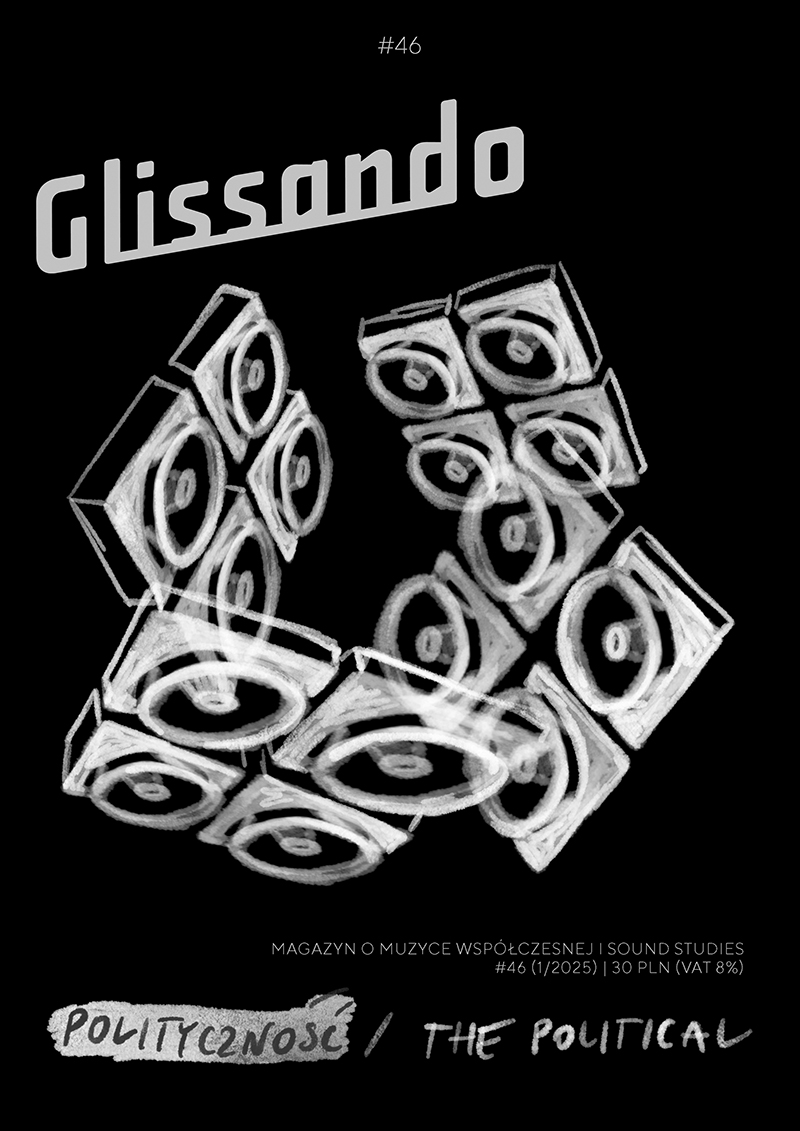
Listening to All the Noise(s): On the Political Nature of Sound – Editorial #46
“Listening to music is listening to all noise, realizing that its appropriation and control is a reflection of power, that it is essentially political,” Jacques Attali wrote in 1977.[1] Nearly half a century later, these words can serve as a point of departure for an acoustemological approach to political reality – understood as an attunement to practices of control, domination, struggle, the drawing of divisions, the forging of alliances, the consolidation of structures, the dismantling of hierarchies, the incitement of revolutions, the creation of alternative communities, the granting and acquisition of identities, the exclusion of others, and decisions over who or what survives and who or what perishes. From sonic terror in authoritarian regimes to the silence that follows trauma; from acoustic propaganda in militarised border zones to small acts of individual resistance, sound does not merely represent power but operates as its instrument, its trace, and its battleground.
This issue of Glissando emerged from a central question: what is the political nature of sound as a fully realised dimension for examining relations of power, subordination, and dependency on the one hand, and emancipatory, alternative, and anarchist movements on the other? The texts gathered here stem from diverse theoretical perspectives, geographical contexts, methodological and formal strategies. Yet they share a common conviction: the political nature of sound demands concreteness. It requires attention to the historical, institutional, and corporeal conditions under which sound becomes a weapon, a testimony, a silence, a new language, or a mode of thinking that opens onto possible political worlds.
I understand the political here in line with the approach presented by Chantal Mouffe – not as a set of practices and institutions that make up politics, but as the antagonism that characterises all social relations. This antagonism can be overt, manifesting in electoral campaigns, parliamentary disputes, demonstrations, revolts, or wars. It can also be embedded in the formal and informal hierarchies of institutions such as schools, corporations, or families. Mouffe, following Carl Schmitt, criticizes the liberal faith in individualism and rationalism, which presumes that it is possible to reach optimal agreements for all participants in the political game. The political is thus a constitutive conflict, grounded in the impossibility of any social order ever becoming total and in the need to accept its ineradicable openness “The lack of political channels for challenging the hegemony of the neo-liberal model of globalization is […] at the origin of the proliferation of discourses and practices of radical negation of the established [neo-liberal] order.”[2] If this order is to be maintained, it must allow for agonism – it must accept a genuine polyphony. Otherwise, conflict internal to the system will transform into anti-systemic action. Sound, in this perspective, would not function as a carrier of political messages but as the very matter of antagonism – that which can be silenced or amplified, forbidden or enforced, community-building or exclusionary. The political nature of sound is not an addition to its physical or aesthetic nature – it is its nature as it unfolds in social space. If the political is constitutive conflict, sound is one of its media – that which reveals or betrays tension even where no words are spoken.
Brandon LaBelle, in Sonic Agency, engages in dialogue with Kate Lacey and her term freedom of listening, denoting a practice that allows voices marginalised in mainstream discourses to be heard. In her view, listening is what guarantees pluralism in democracy.[3] Listening from below can be understood as a continuation of freedom of listening, through which the invisible, the overheard, the itinerant, and the weak can strive toward emancipation. These figures form communities that should not happen – unlikely publics – emerging at the margins and in the cracks of existing regimes of class, ethnic, religious, and national belonging, as well as broader sanctioned normativities. In this way, countless voices find their space in democracy, approaching what Étienne Balibar describes as anarchic citizenship – forms of subjectivity and community that exist in excess of established regimes of citizenship and governance.[4] In this sense, Daria Kondraciuk’s text develops LaBelle’s concept of sonic agency in a functionalist spirit: following Ruud Noyes, she proposes a contextual definition according to which anarchist music is not a genre or a set of themes but a practice – music used within the context of anarchist and protest communities. This opens conceptual space for thinking about alternative circuits not only as opposition to the mainstream but as parallel organisational structures. Anarchist (or subversive) music does not fight for a place in existing institutions but instead creates its own. Iga Batog’s text on the case of censorship during last year’s Darmstadt International Summer Courses for New Music shows the reverse process – here the institution manages audibility. The decision regarding whose music will be performed, whose voice will be admitted, turns out to be an act of power, not a neutral programmatic gesture. The political nature of sound plays out not only in curatorial decisions but also in the infrastructure of market circulation. Piotr Kędziora’s text on the history of EFA Medien – the German distributor of independent music – shows how a DIY project became the bloodstream of content circulation, only to collapse under the weight of export expansion, dependence on retail chains, and the digital revolution. This collapse illustrates Attali’s vision of music as a field of political struggle; changes in models of production and distribution determine the survival or disappearance of specific practices.
Silence and gradual disappearance also constitute a position. Institutions of new music produce their own concealed silences and inaudible voices – repertoires and aesthetics that remain offstage and outside dominant circulation, even though they speak of conflict, inequality, and injustice. These are the terms Michael Freeden uses to show that silence is not the absence of voice but an omnipresent, often unconscious tool for shaping agendas, memory, and collective identities. Concealed silences operate through modalities – the unthinkable, the unspeakable, the ineffable, the inarticulable, the unnoticeable, the unknowable, and the unconceptualizable – that is, the various ways in which politics makes room for what it does not say, does not hear, or cannot grasp.[5] In this context, the pro-Palestinian words used by Ada Gómiz and Ana Dueri in the work Huella Winka described by Iga Batog belong to the unspeakable – a tabooed zone in the political field of publicly funded culture in Germany. By contrast, in Poland synagogue music turned out to be unspeakable – due to antisemitic and anti-German protests, the Września Children Foundation cancelled planned concerts in October 2025 dedicated to the work of Louis Lewandowski. Freeden’s map of concealed silences thus reveals that in the field of sound, too, the political plays out not only in what sounds but also in what remains inexpressible, unspoken, and withdrawn – whether due to taboo or to violence, trauma, and the risk of sanctions.
It is precisely in these spheres of the inexpressible and inaudible that Brandon LaBelle locates sonic agency. According to LaBelle, it encompasses listening and the negation of both sound and hearing. It also denotes the capacity for resistance – an insurgent action understood as excess vis-à-vis state mechanisms of representation and regulation. LaBelle invokes the mass disappearances in Chile under Augusto Pinochet as a radical figure of invisibility and inaudibility, against which practices of listening, archiving, and mourning become forms of sonic agency.[6] Joanna Pietraszczyk-Sękowska’s text, devoted to similar crimes in Peru, reveals the silence of loss prevailing among families – the refusal of testimony as an expression of reclaiming individual control. As the report of the Guatemalan Truth Commission states, a culture of silence and guilt (la cultura de silencio y el sentimiento de culpa) emerges, in which victims and witnesses are locked in the impossibility of speaking what they saw. At the same time- as the report warns – silence becomes the silence of the future (los silencios del futuro): if trauma is not worked through, it will be inherited by subsequent generations.[7] Kika Echeverría’s text on Chilean women’s protests illustrates the agency of screaming combined with visibility. The choice between silence and scream, however, is not available to everyone. The voice of women in Afghanistan under Taliban rule has been penalised, expelled from public space, subjected to control in domestic spaces, and Radio Begum – the Kabul-based medium for Afghan women – was shut down in February 2025. The political nature of silence can be a weapon or a prison.
LaBelle’s figures of the itinerant and the overheard also appear in Pavel Niakhayeu’s text, as do the weak – in the texts by Małgorzata Heinrich, Anna Wójcikowska, and in Filip Szałasek’s auto-acoustemology. These are migrants, refugees, African Americans, children – victims of war, and institutional violence. Sonic agency understood in this way shifts emphasis from representation to relations, specifically to who listens to whom and under what conditions, and who remains unheard. Pavel Niakhayeu’s autoethnography of listening under Lukashenko’s authoritarian rule illustrates protests that devolve into acoustic paranoia – the fear of being surveilled, imprisoned, tortured. This paranoia, however, has an entirely real basis. The regime’s digital surveillance—facial recognition systems – is supported by audio surveillance, namely voice recognition. The future may be even more unsettling. In March 2025, Jia-Xin Zhong, Jun Ji, Xiaoxing Xia, and Yun Jing published research on technology enabling the creation of sound zones isolated from their surroundings – audible enclaves.[8] Beyond potential civilian applications – headphone-free audio guides or personalised zones of silence in cities – one can imagine their use in crowd control, individually targeted propaganda, or sonic political manipulation.
Małgorzata Heinrich analyses Rickerby Hinds’s Dreamscape – a hip-hop theatre work created in response to the killing of 19-year-old African American Tyisha Miller by police in 1998. Heinrich focuses not on the act of racial violence itself but on how hip-hop as a dramatic form enables ritualised mourning and the subjectification of the victim. Dreamscape is not merely a scream of protest nor a silence after trauma – it is testimony and catharsis.
Filip Szałasek proposes a response to trauma different from silence, scream, or testimony—speaking through an acoustemology of the self, that is, autoethnographic listening that becomes possible only after working through difficult past experiences. His trauma does not stem from state terror but from the lawful functioning of quasi-total institutions (school, warehouse). Acoustemology – a term coined by Steven Feld as a sonic way of knowing and being in the world – becomes, in Szałasek’s hands, a tool of reclaiming meaning.[9]
Listening activates a phenomenological naming that, in Voegelin’s reading of Kripke and Merleau-Ponty, is neither ontological nor etymological – it does not rely on ready-made categories but attempts to grasp and convey what is heard.[10] Such listening opens space for thinking about sound as a way of inhabiting multiple possible worlds at once. In Salomé Voegelin’s The Political Possibility of Sound, listening and voicing destabilise visual epistemologies based on distance and objectification.[11] Such destabilisation can be observed through reading Slavek Kwi, who, through the artistic persona – the virtual being entity sonoent00 – calls into existence a community of abstract listening. The dialogue that arose during editorial work, and was incorporated into the description of clusters of the abstract listening process, creates a micro-archive of the resonance between a phenomenologically oriented artistic project and the logic of editorial curating of an issue rooted in the epistemology of social research, where terminological clarity and transparency of processes are the norm.
Salomé Voegelin writes in Sonic Possible Worlds about such worlds as private worlds where the interpretation of reality is negotiated through the process of translating mine through yours and yours through mine.[12] Actual reality is thus one of many possible configurations, and worlds are multispecies: they also include nonhuman actors and their modes of sonic existence and hearing. Sonic possible worlds emerge in Agata Dyczko-Brat’s text, where listening to spring peepers in Będkowska Valley and reading Mark Fisher’s The Weird and the Eerie reveals relations between a local aquatic microworld, the listening and recording subject, and the spectres of late capitalism. Agnieszka Szynk-Mika’s analysis of Simon Løffler’s Animalia reveals the political nature of theatre as a laboratory of multispecies co-habitation – a place where human/nonhuman hierarchies are negotiated not at the level of declaration but through material relations of bodies, gestures, and sounds on stage, preceded by attempts to embody nonhuman experiences in artistic research accompanying the work. In Weronika Bielecka’s conversation with Lei Liang, sonic possible worlds take the form of compositions based on Arctic research and the Inuit calendar. Listening becomes a way of co-creating multispecies, intercultural models of habitation, in which the rhythms of climate, the knowledge of Indigenous communities, and the languages of music and science negotiate their mutual translations. Marianna Lis’s text shifts this perspective toward the relation between human, nature, and culture. Discussing the work of Nursalim Yadi Anugerah, she shows how Dayak music encodes cosmologies of harmony between people, forest, and earth spirits. The deforestation of Kalimantan simultaneously disrupts ecological, social, and sonic orders. Lawing – a piece based on data on mass tree felling, performed on traditional keledi mouth organs powered by mechanical breath, reveals this disruption. The machine (an air compressor) sustains the sound while simultaneously creating dissonance between the organic instrument and the mechanical drive, exposing the scale of intervention in the local order of the world.
According to Voegelin, sound need not respond to violence with counter-violence. She illustrates this theoretical proposition with Lawrence Abu Hamdan’s audiovisual installation Language Gulf in the Shouting Valley (2013), which juxtaposes two situations: recordings of translations performed by Druze interpreters in Israeli military courts in the West Bank and Gaza Strip, and Druze families meeting in the so-called Shouting Valley on the Golan Heights, separated by the Syrian-Israeli border, shouting to one another. The voice thus crosses physical barriers and minefields, becoming an acoustic leak, while simultaneously functioning as a medium of power.[13] In this issue of Glissando, the Israeli-Palestinian conflict appears in several contributions: in Mariam Menawi’s text presenting the soundscape of Gaza during the current phase of the war from the perspective of Mohamed Yaghi, a sound engineer and designer; in Anna Wójcikowska’s interview with Zygmunt Krauze on Children’s Requiem; and as one of the examples discussed in Igor Wiśniewski’s text on protest communities, which references selected projects of the Cities and Memory initiative. In all these cases, sound does not respond to violence with counter-violence but becomes a form of sonified testimony. It documents trauma, mourning, and resistance, making audible experiences that, within the logic of hard politics, remain statistics or silence. Sonic possible worlds are not abstract utopias but practices of working through very concrete orders of violence – from plantation capitalism and climate catastrophe to border and occupation regimes.
Such a postulate of non-violence and sonic possibility, however, remains largely conceptual. Recent years – marked by the intensification of armed conflicts, the erosion of international law, and the militarisation of borders – demonstrate that the practice of international relations continues to operate within a paradigm of brutal violence, in which voice and sound function primarily as tools of propaganda, intimidation, and control, rather than as media of alternative worlds. This tension is particularly visible in Yechan Moon’s text on the loudspeaker war in the demilitarised zone between South and North Korea (DMZ). This space of radical military control becomes a site of sonic warfare. Moon describes how loudspeakers emitting K-pop construct an alternative reality for North Koreans, while the North responds with its own noise – animal howls, gongs, and inhuman shrieks. This example epitomises sonic warfare in the sense articulated by Steve Goodman.[14] Sound acts directly on the body and mind, which is why it proves so effective as a tool for demarcating boundaries and zones of domination. The political possibility of sound does not negate the paradigm of violence but enters into tension with it: as a marginal, fragile practice of listening and imagination that does not immediately transform the geopolitical order but registers its fractures and singularities.
The structure of this issue leads from the most explicit and direct manifestations of the political nature of sound – sites where the state deploys sound as a weapon, where propaganda resonates along borders, where crimes against humanity leave behind rhythms impossible to articulate in words – toward forms that are less visible but no less significant. This movement proceeds from international conflicts and state apparatuses to individual bodies and intimate experiences; from hard politics to the political in a broader sense; from direct violence to structural violence; from visible terror to invisible mechanisms of exclusion and control. From Latin America, through the Middle East and Asia, to Europe, the contributions trace the political nature of sound in authoritarian regimes, protest movements, distribution networks, and listening practices, resisting an exclusively Eurocentric perspective. The issue gradually descends further – from macrostructures of power to the ways in which they inscribe themselves in individual trauma, generating silence or scream, giving rise to communities of resistance. Passing through the institutional frameworks that structure the musical field (who can create, who can listen, and under what conditions), it ultimately reaches alternative ontologies of listening and relations with the nonhuman world. The political nature of sound emerges here not as a thematic supplement to established heuristics of political analysis, nor as an abstract ontology of vibration but as a method of inquiry: a way of examining regimes of audibility, documenting violence, forming protest communities, and inventing new languages for a world in disintegration. What remains absent – algorithmic infrastructures of platforms, further examples of data sonification, voices that could not sound – is as significant as what is present. This issue does not document all conflicts: there are no dedicated accounts from Sudan, Myanmar, or Ethiopia; race appears primarily through analyses of hip-hop and police violence; gender and queer perspectives remain only lightly sketched rather than articulated as autonomous axes. These missing registers persist as a subdued background — a reminder that every archive of the political nature of sound is necessarily selective, and that the work of listening begins precisely where this issue falls silent.
[1] Jacques Attali, Noise: The Political Economy of Music, transl. Brian Massumi, University of Minnesota Press, Minneapolis – London 2009, p. 6.
[2] Chantal Mouffe, On the Political, Routledge, London – New York 2005, p. 82.
[3] Brandon LaBelle, Sonic Agency: Sound and Emergent Forms of Resistance, Goldsmiths Press, London 2018, p. 87.
[4] Ibid., p. 47–48.
[5] Michael Freeden, Concealed Silences and Inaudible Voices in Political Thinking, Oxford University Press, Oxford 2022, p. 103–136.
[6] B. LaBelle, Sonic Agency…, p. 155.
[7] Comisión para el Esclarecimiento Histórico, Guatemala Memoria del Silencio, Oficina de Servicios para Proyectos de las Naciones Unidas, Guatemala 1999, centrodememoriahistorica.gov.co/descargas/guatemala-memoriasilencio/guatemala-memoria-delsilencio.pdf, pp. 1408, 1577, access 21.01.2026.
[8] Jia-Xin Zhong, Jun Ji, Xiaoxing Xia et al., Audible Enclaves Crafted by Nonlinear Self-Bending Ultrasonic Beams, „Proceedings of the National Academy of Sciences”, vol. 122, no. 12, 17.03.2025.
[9] Steven Feld, Acoustemology, in: Keywords in Sound, eds. David Nova and Matt Sakakeeny, Duke University Press, Durham – London 2015, p. 12–13.
[10] Salomé Voegelin, Sonic Possible Worlds: Hearing the Continuum of Sound, Bloomsbury Academics, 2014, p. 163.
[11] Salomé Voegelin , The Political Possibility of Sound: Fragments of Listening, Bloomsbury Academic, Bloomsbury Publishing Inc, New York 2019, p. 156.
[12] Salomé Voegelin, Sonic Possible Worlds…, p. 33.
[13] Ibid., p.22-25.
[14] Steve Goodman, Sonic Warfare: Sound, Affect and the Ecology of Fear, The MIT Press, Cambridge Massachusetts – London 2010, p. 5–13.