

Handling (the) Noise
My first recordings on the 9th of August, the day of the elections, contain lots of handling noise: sounds of clothes swishing against the audio recorder while I walk around the city center to see milicyja block posts, convoys of internal troops trucks and armoured cars of special units. People in the streets talk normally, some relaxed, some drunk – a regular summer weekend soundscape.
A couple of hours later, when preliminary results of the elections were announced – predictably, Lukashenka was declared a winner – Internet was blocked. As dusk fell, noises rose – imperceptibly, but irreversibly, like water simmers and hisses before reaching the boiling point. First, honking of cars became louder, more frequent, rhythmic and sustained. Then – a distant noise of crowds, people shouting and sirens. Then came explosions of flash bang grenades and gun shots.
Further recordings were not just of handling noise, but of noises of people handling the situation of blatant lies and brutal violence, and of the authorities handling the noise produced by protesters and producing its own noise. Hours and hours of audio contain sounds of demonstrations, rallies, propaganda and people laughing at it, songs, chants, curses, concerts, poetry – and pushing back the riot squads with our voices. My voice is there too.
There are discussions on whether field recordists may be present in their recordings or should eliminate their audible traces, leaving a „pristine” recording not spoilt by their intrusive noises.[1] While recording the protests, I couldn’t erase my presence even if I wanted to. It’s captured in many forms – not just in handling noise, but in sounds of my steps – calm or fast, in my loud breath when we ran through courtyards escaping the “kettling”, my voice – talking with those around me, chanting and shouting, laughing, singing, elated or anxious. I can distinguish whether I’m wearing a cloth mask or not. And I clearly hear my silent evasion when a plain-cloth officer asks me quietly to “come aside for a word” but I just dive in a crowd of protesting grandmas taking with me photos of this officer detaining a journalist.
“BLUR HIS VOICE!” – writes someone in a comment under a YouTube video where a man speaks frankly and risks being identified by security services. After a few months of proudly posting their photos from demonstrations, people started hiding their identities, deleting photos and videos, and independent media started blurring and pixelating faces.[2] But audio recordings of voices are still largely considered safe, less prone to algorithmic identification. Security services began pixelating officers faces in their media much earlier – and it is a usual thing for them to pitch-shift and distort their voices on TV and YouTube when they talk about yet another “extremist” arrested or are abusing detained people on camera. Detainees’ voices are never protected. They may be scared or defiant – but they’re always “naked”, unfiltered, not covered up by voice mangling plug-ins.
I can’t put an acoustic blur or de-noiser plug-in to depersonalize my recordings. And I don’t want to.
Sonic resistance
“Political activity is whatever shifts a body from the place assigned to it or changes a place’s destination.” – Jacques Ranciere[3]
2020 was the loudest and most politically active year in the recent Belarusian history. The state was so shocked by the people’s uprising, that now, five years later, protesters are still hunted for taking part in demonstrations and any activity deemed political. Hundreds of thousands of bodies shifted from places assigned to them. They protested, walked at wrong time and in wrong places, they resisted. They sang, made noises, played music and danced – like never before. There were not enough police vans to transport them and not enough prison cells to pack them all, even if up to 50 people were packed in a 3-4 person cells. Cells and vans became places where thousands experienced hardship, pain and solidarity together and forged into a new collective body of non-compliance.
Over these years, new ways of sonic resistance were invented and used. I can’t even list all the ways people expressed themselves sonically. Most of this could be heard during demonstrations gathering tens, hundreds of thousands of people who chanted and sang as they walked – often led by musicians playing protests songs or drum rhythms. The largest demonstrations happened every Sunday, but there used to be also Saturday female marches, demonstrations of pensioners and people with disabilities on other days.
The authorities tried to pacify the protests not only with flash bang grenades shot at point blank and causing serious injuries and deafness. They’ve also used music to drown protesters’ voices. Locations, sacred for the state, like the Great Patriotic War Museum and Victory Square, were protected by military sound systems airing Soviet and contemporary patriotic songs.
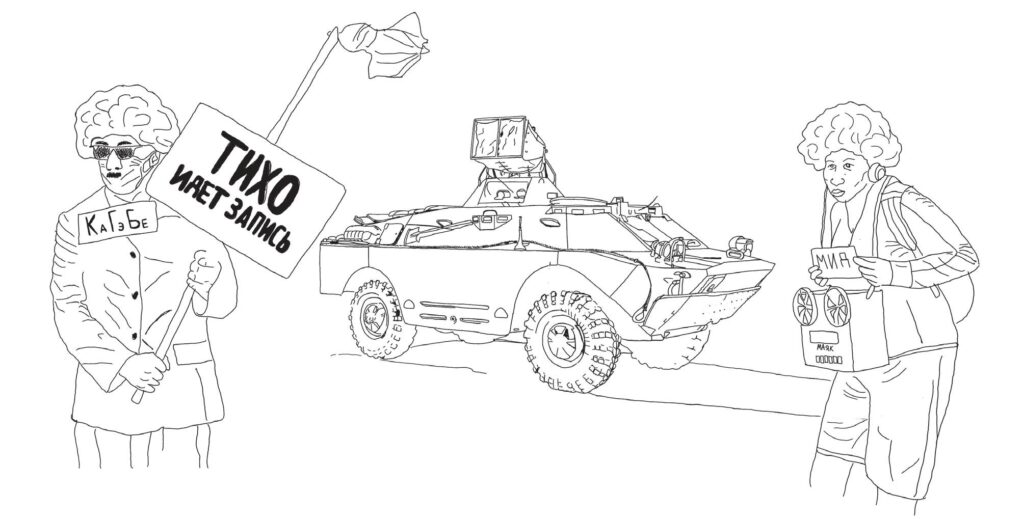
“Quiet. Recording”. Protesters dressed like clowns and parodying the wiretapping and eavesdropping agents of KGB and the Ministry of Foreign Affairs; in the background – ZS-82, a Soviet military broadcasting system deployed against protesters (image – Pavel Niakhayeu)
Protesters, in their turn, created their own acoustic territories, temporary autonomous zones and sonic barricades. Among the most important ways of cultural and sonic resistance, were DIY cultural events organized at residential neighbourhood courtyards – concerts, poetry readings, theater performances, choir singing and tea parties. The few months from August till November were a unique period in the global history of the cultural and sonic resistance. While similar events were happening in other Belarusian cities at that time, Minsk became the center of this movement that created a defiant city-wide festival, an audiotopia with dozens of neighbourhoods self-organizing cultural events and competing for bands, poets, theater companies and lecturers. These concerts and tea parties held in places that everyone passes every day without noticing them, became the centers of protesting local communities that even created their own flags and anthems. Often, these evenings ended with arrests of musicians and listeners and by December 2020, organizing them became too risky. Also, the mood has changed, especially in mid-November, after the death of Raman Bandarenka, an activist of one of such local communities.
As the protest went underground, the political soundscape of Belarus became quieter. And new forms appeared – anonymized videos with amateur choirs singing protest songs, making dance flash mobs – like “One Billion Rising”, “shouting” and “singing windows” – when people chanted “Long Live Belarus!” and played music from their windows.
In 2020, many people had some protest song set as a ringtone. I’ve heard about a funny scene at a milicyja department where detained people were brought after a demonstration. Their confiscated smartphones were lying on a desk of an irritated officer who struggled with these phones as they played different protest songs every few minutes when people called, worrying about their friends and family members.
A few months later such scenes would be unimaginable. The atmosphere was filled with acoustic paranoia – fear of being heard, eavesdropped, wiretapped, identified, denounced, jailed and tortured.
A Bug Smaller Than a Fly
– It can be smaller than a fly. A speck of dust – sitting in a corner and listening.
It’s summer 1991. My father and his friends are discussing rumours about the newest KGB “bugs” – microphones capable of eavesdropping anyone while staying completely unnoticeable.
I’m thirteen years old and have already seen my share of Soviet and the Warsaw Pact spy movies and TV series showing brave and cunning KGB officers planting hidden microphones into CIA agents flats to uncover their dirty plots.[4] But these were films and books. Why do my dad and the men he works with at the factory, the ones he trades Western rock-music tapes with, care about these bugs?
It’s summer 1991 and my father is involved in trade union movement, he’s a vice chairman of their factory’s union – and its camera man, filming workers’ strikes in Vorša and Minsk with a bulky Panasonic M7 camcorder.
Today they’ve brought huge loudspeakers, amplifiers and microphones to our flat. It’s August 1991 – the Soviet Communist Party hardliners attempted a coup; therefore, my dad and his friends are organizing a rally tomorrow at the Lenin Square in the city center – a meeting of local workers aimed to support democracy.
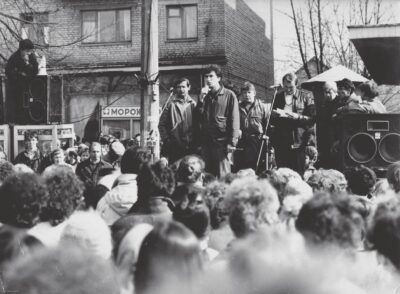
Mikałaj Razumaŭ speaks during the railway blockade, Vorša (Orsza), 24.04.1991,
Unknown photographer. Source: Center for Civil Society Research, https://vytoki.net/?photo=00022187
Just a few days ago a group of workers „confiscated” their leader, Mikałaj Razumaŭ, right from the courtroom in Mahiloŭ where he was under a trial for a railroad blockade. In April that year, thousands of workers blocked the station – a strategic crossroads of Moscow-Brest (and further West) and Leningrad-Kyiv-Odesa railways. During the blockade, they were in touch with Lech Wałęsa’s office, and, according to Razumaŭ, Wałęsa’s aide asked him how far they’re ready to go: „What if blood sheds?”[5] Luckily, there was no blood. There were so many people that milicyja decided not to use force.
– We could’ve been shot there and then. But our friends, train machinists, placed oil tanks on tracks everywhere around. And they knew that if they start shooting there’ll be hell that they will be responsible for.
It’s 2010 or 2013 and I ask dad – for the Nth time – whether he can show me his video recordings of the 1991 blockade. He refuses once again, explaining that the tapes are hidden securely, and no one should see them while people involved in organizing the blockade and the strikes are still alive. He was probably right. Now, after 2020, I understand how dangerous archives can be. My father’s life, just as lives of many his comrades, was ruined because of his involvement in the workers movement. In 1994, many of them voted for Lukashenka, thinking that he’s one of them, that he’ll protect interests of workers and peasants and will kick out the old Nomenklatura that stayed in power after 1991. They were terribly mistaken: very soon Lukashenka usurped all the power and started persecuting not just the „Nationalists”, but trade union activists too – even former ones – seeing a threat in any activism. All they were „the BNF people”[6] in the eyes of the state, milicyja and KGB that retained its name, its goals and its methods.
“Who told you that with the (Soviet) Union and the Putch
KGB’s power suddenly ended?
I experienced all this myself
Suddenly, “accidentally” my ribs got broken”[7]
In 2014 my father died, and I have never seen those tapes. I don’t know if they exist somewhere or have rusted away in a forgotten stash at one of dad’s deceased friends’ dachas.
In 2020, fear of being eavesdropped and wiretapped poisoned all the society and Belarus reached a new level of paranoia. Not only political activists were careful about what, where and with whom they’re talking about, but high-profile state officials and top officers of security forces couldn’t feel safe because of the wave of phone-calls leaks revealed by pro-opposition hackers – the Cyberpartizans. In 2021 they’ve published a map of denouncers – people who called milicyja emergency numbers to inform about suspicious political activity of strangers, neighbours and even family members. Discovering that your smiling neighbour is in this database was shocking and made people even more careful. This fear was also reinforced by rumours that there are microphones planted in certain public places – at and near popular cafes, at bus stops and on the central streets.[8] More and people avoided talking over phones and were careful about their communications in general.
By 2021, using my phone at all, let alone picking a call from an unknown caller was something I, as many Belarusians, wouldn’t do. When such calls became frequent, it usually meant that you’re hunted for and need to take measures – change your number, clean up your gadgets, maybe get a new phone, move to another flat, start arranging your escape.
“And even those who stayed in Belarus also hope for the changes, but are very, very afraid. I have friends, girls working in cafes, restaurants – and when they want to talk, they go to freezers, where even mobile phone connection doesn’t work, and they discuss something there. They are afraid to talk at a table when drinking coffee.” [9]
A couple of years ago, Cyberpartizans claimed that it is impossible for the authorities to listen to everyone’s phone calls because of limited resources,[10] but a permit to listen to anyone can be easily obtained, so it’s better to be careful and use messengers instead. Messengers cannot be fully trusted as well, especially the most popular one, Telegram, which became essential for communication but whose security is questionable. Independent media regularly update guidelines on digital security for the general public. Once the preoccupation of political activists, now it is something more and more people are concerned because all the independent media are considered “extremist” and reading, watching or listening to their content, commenting and sharing it – even in the form of a like – can lead to fine and short arrest in the best case, and to a criminal sentence in many cases.
Paranoia, including the fear of eavesdropping, is no longer an intra-Belarusian problem but is exported abroad. Together with half a million exiled Belarusians, it spreads into Poland, Lithuania and other countries, wherever there are any gatherings of our diaspora – and not just political rallies or conferences. Even small circles of Belarusians gathering for cultural events – book clubs, concerts, arts and crafts classes, or pub quizzes – are not entirely safe. Lukashenka’s agents, equipped with “double” passports issued under false identities, infiltrate these groups. They film and photograph participants, copy attendance lists, and secretly record conversations in order to discredit or intimidate them. Kompromat and threats directed at their families still living in Belarus are then used to coerce them into cooperation. The agents also exploit the vulnerable circumstances of Belarusian emigrants – including poverty, unemployment, or health problems – to extort information and smear the diaspora and the political structures of the opposition.
Erased Memories \ Lost Archives
In the summer of 2025, a Soviet radio-jamming tower was dismantled in Minsk – a new KGB Institute will be built there instead. Built in the 1950s, the tower had been part of a network designed to prevent Soviet citizens from listening to “enemy voices” – Radio Free Europe/Radio Liberty, Voice of America, the BBC, Deutsche Welle, and others. In 1963, a group of Minsk students led by Sergey Khanzhenkov planned to blow it up, but they were infiltrated by a KGB agent and imprisoned.
It is symbolic and ironic, that the last jamming tower was dismantled in the same year when Trump decided to defund and shut down RFE/RL and VOA as “leftist propaganda”. Since its launch, Radyjo Svaboda, the Belarusian language service of RFE/RL, has been a hugely important media and by now it’s the only one using the classical Belarusian orthography, publishing articles and books in it. Its website is an invaluable archive of the contemporary Belarusian history and culture. It is now banned in Belarus, just as Belsat – a Belarusian language TV channel aired from Poland, and dozens of other foreign and Belarusian non-governmental media.
There was a roughly thirty-year gap in secret listening, and, since 2020, these practices, well known to previous generations of Belarusians, were adopted by new generations. Only now people don’t listen to the radio on their receivers, but listen to it online, read the banned news on the internet and watch YouTube streams. They must also learn how to hide these habits and erase traces of reading, watching, and sharing such content.
In 2023, another factory worker and amateur cameraman turned chronicler, Siarhei Čyryk, died. Since the 1980s, he too had been filming strikes and rallies – but unlike the enthusiasts of earlier decades, he made documenting opposition life his main occupation. In his final years, despite having very little money, he dedicated himself to digitizing his vast video archive and posting short clips on Facebook. Shortly after his death, the page with his videos disappeared. Who knows what happened to his tapes and digital files? Drawing attention to them would be dangerous for his family.
A similar fate befell to the archive of Uładzimir Karmilkin, who not only photographed, but also audio-recorded opposition actions since the late 1980s. He hoped that someone would use his archive materials to create new films about the contemporary Belarusian history. But his archive disappeared too.[11]
This intentional and unintentional erasure is the main factor of historical amnesia that produces illusion of “political silence” in Belarus. Taciana Astroŭskaja (Astrouskaya), who wrote a book about the Belarusian dissident movement of the Soviet era[12] mentions this erasure and the country’s isolation as one of the reasons why many people, including academics, think that “it was all quiet” here.
For years, I’ve been preoccupied with the issue of archiving independent cultural scenes and communities. First, I became curious about the disappearing legacy of our electronic music scene, then about music scenes in general. And since 2020, I become increasingly aware of the large-scale erasure of information about contemporary Belarus in general. Not only were independent media websites blocked or destroyed by the authorities then. People had to delete their digital and analogue archives for safety reasons. And although more cultural activists recognize the value of archiving their communities, these photos, videos, and documents pose real danger to members still living in Belarus – even those who have stepped back from their activities. Collecting and preserving these materials in the hope that, in several years or decades, it will become safe to speak about them is a painful, technically difficult, financially burdensome – and frankly dangerous – undertaking.
Loudspeakers are political
I have managed to preserve only several screenshots from one of Siarhej Čyryk’s videos – about a 1998 rally in Minsk commemorating the 50th anniversary of the UN Human Rights Declaration. In these screenshots there is an unmarked milicyja “Volga” car with a huge megaphone. On another – a man with several megaphones held to his mouth. The man is Ales Bialacki, a Nobel Peace Prize laureate currently held incommunicado in prison.
Before 2020, all the opposition rallies and demonstrations – authorized and not – depended on sound equipment – megaphones, microphones and large loudspeakers, like those my father’s friends brought to the city squares to support democracy. There was always this cat – and – mouse game between rally organizers and security services that tried to seize their equipment.
In August 2020, Vlad Shaker, one of the oldest Belarusian DJs and one of the best live audio engineers, provided a sound system for a concert at the Independence square. The equipment was confiscated and, a few weeks later, Shaker was arrested, charged with drug dealing and sentenced for a long term.
It was clearly not an era of huge loudspeakers. And people used smaller, more portable solutions like Bluetooth speakers that they put on their windowsills to play protest songs. And they took portable speakers to demonstrations.
“Rave Not Dažynki”[13] – was the slogan of music marches with Bluetooth speakers in August 2020. Vika Biran, a queer activist, writes in her book[14] about these demonstrations, inspired partly by Georgian protest raves. One of these demonstrations even passed by the KGB building with masked officers observing the colourful crowd but not intervening.
Anarchist drummers were often a part of a protest soundscape in Belarus. During the 2017 protests against the “parasite tax”[15], a group of drummers lead the demonstration and was brutally detained later. In 2020, drum ensembles were a regular feature of protest marches. They either played samba-like rhythms on the go or were sitting in wheelchairs and platforms made of warehouse pallets and pulled by people and bicycles. Drummers were hunted and punished hard.
You could hear all kinds of music during demonstrations – either live or reproduced. A fantasy-folk band Irdorath played protest songs on bagpipes while leading a column of protesters – and were later jailed for two years. Among the most spectacular music protest performances were DJ sets by Alaksandar Bahdanaŭ – DJ Papa Bo Selectah. An experienced music manager and club promoter, he was running the “Korpus” – a creative space in a former electronic factory building. In May 2020, during the Victory Day parade preparations, he played an anti-war DJ set – with tanks passing by in the background[16]
And in August he took a DIY mobile CDJ-system to demonstrations, playing on the move and livestreaming his sets.[17] A year later, he and his companion were arrested, beaten, and imprisoned. After being sentenced to a correctional labour colony, they managed to escape the country. In exile – first in Georgia, then in Poland – Papa Bo continued DJing and organizing musical events in support of Ukrainian refugees and Belarusian political migrants. He launched the Belarusian Outside Sound System, an initiative promoting and releasing Belarusian music abroad. You can find him at all major music events of the Belarusian diaspora.
Music and Politics
As I was writing this article, yet another Belarusian musician was arrested – Aleh Khamienka, the leader of a folk-rock band Pałac. He was accused of collaborating with an „extremist media” and a criminal investigation was opened against him. He was recognized as a political prisoner – one of thousands. Each time another musician is arrested, there are typical comments in media and on social media platforms: „Why was s/he still in Belarus?!”
In recent years, it’s almost became a “default” shared belief that an artist or activist who continues “doing something” and does not support the regime, should have already emigrated – and not just for personal safety, but also in order to avoid placing additional pressure on the clandestine networks that help with emergency evacuations (that is, helping people flee Belarus), as well as on their own families and friends, who may be forced to support them while they are in prison. As if by choosing to stay, people not only assume responsibility for their decision, but also inherit blame for it. This misplacement of guilt has become a sign of the times and reflects how deeply traumatized Belarusian society is.
The political polarization that divides Belarusian society now, has made it nearly impossible for musicians to stay apolitical. Even if political themes are absent from the songs, titles, and political imagery does not appear in music videos, and even if musicians don’t talk about politics in their interviews (which is rare now), the events of 2020 and 2022 forced many of them—if not to openly declare their allegiances—then at least to position themselves in relation to this split.
A previously widespread cliche „my music is beyond politics” and „we’re for all the good things” is now a clearly political one. You just can’t be neutral. And often it was the musicians’ fans who forced them to take sides in the conflict by asking direct questions on their social media platforms.
Through the voices from the “show biz” loyalists, the regime now demands an active, clearly expressed loyalty from the artists. Evgeniy Oleynik, one of the “court” composers and songwriters, claims that 2020 changed the demand for music: entertainment projects are no longer relevant. He also proposed to create, together with the presidential administration, an institution that would criticize and condemn artists who supported the protests and not the regime[18]
All the arrests, imprisonments and repressions, the closure of venues, the confiscation of equipment, and emigration of music scenes actors led to radical transformation of Belarusian music scenes – not just of the „protest rock”, as in the 1990s-2000s, but of all of them, from folk to rap, from punk to electronic music, from pop to jazz and academic / classical. Not a single genre has remained untouched. Even some pop-musicians who used to show loyalty to the state by performing at official concerts and festivals, came under criticism and sometimes under repressions.
At least half a million people have left the country since 2020, with most of them settling in Poland. Among them are musicians and a significant part of their audience. The uprooted music scenes of Belarus now function both in diaspora and at home, experiencing new challenges but also new opportunities. Most of the emigrant musicians continue their creative activities but now they have other everyday challenges.
The war drastically altered the Belarusian context. After February 2022, when Russia invaded Ukraine from the Belarusian territory, being Belarusian suddenly became associated not with pride in a peaceful, creative, musical protest movement, but with the shame of belonging to a co-aggressor state. This acute shame, coupled with anger toward the authorities, led many to publicly express solidarity with Ukrainians fighting for their country’s survival. The 70,000-strong anti-war protest in Minsk on 27 February 2022 once again employed sonic forms of resistance: cars honking, people chanting and singing in the streets. This protest was hardly noticeable from outside of the country, but it was very important for the Belarusians themselves.
The issue of Belarusian identity among musicians is just as difficult – on several levels. Some artists, especially those who already obtained new citizenship, position themselves as artists from their new cities downplaying or cutting off ties with their origin. Others highlight their Belarusianness, explaining what it means for them, and why our nation and its people deserve respect. When Polish promoters include Belarusian artists in their line-ups (a rare occurrence), they sometimes omit their nationality as well. For example, a Belarusian folk-electronic band might be advertised as performing or remixing “traditional Slavic songs,” rather than specifically Belarusian ones.
There was a discussion on Facebook in 2025, when a Belarusian music journalist and manager Dmitri Bezkorovainyi noted sadly that only a couple of Belarusian artists had applied to perform at the Music Week Poland showcase festival, despite the dozens of Belarusian musicians and bands currently living in Poland. It later emerged that the festival application form asked only about current place of residence, not citizenship or national identity. In fact, at least seventeen Belarusian artists and bands living in Poland had applied, and three of them – Volski, Kassiopeia, and Sons of Deni – were selected to perform.
Diaspora Festivals
It’s a rainy July Sunday in Kraków. Henryk Reyman Stadium erupts in a roar as Wisła scores yet another goal against ŁKS Łódź. Just next to the stadium, in Park Jordana, the soundscape is different. There is a perfect midpoint in the park where you can simultaneously hear the roaring football fans to your left, Belarusian folk songs to your right, and cosmopolitan electronic music right in front of you.
Today, the sixth edition of a Belarusian festival Picnic Letucień (or LTCŃ) is taking place here, blasting rock, ethno-electronica, hip-hop and techno beats and filling the space with songs in Belarusian, English and Ukrainian. What began as a small friendly picnic in 2020, has grown into an event drawing a few thousand people – mostly Belarusians from Kraków and other Polish cities, but also their Polish and Ukrainian friends. It now features three music stages – Main, Ethno, and Electronic – as well as a handicraft market, a food court, several workshop zones for children and adults, and tents run by Belarusian and Polish NGOs.
In the education tent, a panel of musicians and critics discuss the state of Belarusian music in exile and back at home. One of the issues raised is the “ceiling” for Belarusian musicians. „There are just four Belarusian festivals in Poland, and you can play maybe one solo concert in each city a year”, says one speaker. Another mentions that he has his own ceiling limiting his artistic growth – a day job that he must organize his creative life around.
LTCŃ Ethno stage wraps up at 7 PM, then the electronic scene switches off, and people gather around the main stage for headliners – band. They were among the main heroes of the 2020 DIY concerts in Minsk courtyards, their concerts were raided, and they were detained. They later emigrated to Ukraine and then to Poland, where they now live. Each year they return to LTCŃ to play their funky rock and sing their catchy songs in Trasianka – a mix of Belarusian and Russian – about ordinary boys and girls. But their lyrics now reflect their new surroundings. In one of their new songs, the protagonist compares his lover’s heart to the closed doors of the nearby Biedronka; now, he says, he will have to seek solace at Żabka. Aside from these newer, “Polish” songs, the audience knows all the old lyrics by heart and sings along, remembering those courtyard concerts of 2020.
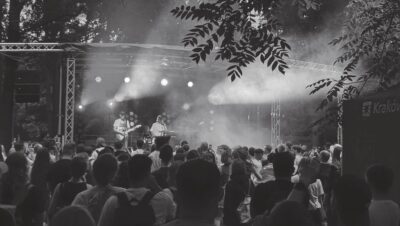
RSP performing at Picnic Letucien, 26.07.2025, Krakow. Photo – Pavel Niakhayeu
The scheduled program is over, but the stage hosts announce a surprise – a band that was not on the line-up. It is not even a band as such, but a group of musicians from various groups who will perform songs of a band whose name goes unspoken:
“Imagine you’re at a kitchen party, where one friend picks up a guitar, another plays the drums and together you sing your favourite band’s songs.”
Well, it certainly is not a kitchen party. The musicians play driving rock and people recognize the lyrics in Belarusian – and realize what is that band that cannot be named even here, in a supposedly safe country.
The band was classified as “extremist” by Lukashenka’s regime in 2024 and three of its members are currently under two and a half years of house arrest. Before the trial, they were forced to record a „repentance video” and denounce their involvement in the protest activities. Their most popular music video is now deleted from YouTube. Filmed right at the street demonstrations in August 2020, it featured hundreds of identifiable protesters’ faces.
Only one band member, the guitarist, lives in Poland and is playing now as a part of this ad-hoc super group. Backing vocals are provided by the women of the folk trio Kriwi, giving the songs an entirely new dimension. The drummer wears a balaclava – and here it’s not a fashion accessory, but a necessity.
Rumour has it, that LTCŃ wanted to invite another hugely popular band whose members are scattered between Belarus and Poland – but those in Belarus were refused visas. Their fans in the diaspora may not even know that, because – right! – “all the worthy musicians have already left”, as the cliché goes. They haven’t. And, surprisingly, other musicians also manage to perform in the EU sometimes while living in Belarus. They are like photons in superposition – “existing in multiple locations at once, until observed„. I will not name the names here (aha, silence! self-censorship! or research ethics?), because in their vulnerable (super)position, their location, and freedom to choose it, can change any day. This game gets harder and harder to play, as it is extremely difficult for a Belarusian to obtain an EU visa now, let alone plan an international tour.[19]
***
As of 2025, there is a number of major summer music festivals in Poland, organized by Belarusians for the Belarusian audience mostly (though Poles, Ukrainians and foreign visitors also attend). All of them started after 2020 as the new waves of Belarusian migrants were coming to Poland.
Krakow’s LTCŃ gathers thousands of Belarusians from Malopolska, Silesia and South of Poland in general. Varušniak, held in Warsaw, focuses mostly on electronic music and is aligned with an important pagan (or Slavic, as Poles prefer to say) festivity—Kupalle (Kupała).
Tutaka is the largest of the Belarusian diaspora festivals in Poland and is the one most saturated with symbolism, including political one. It happens on the same forest glade in Podlasie where for thirty years, in 1990-2019, a legendary Belarusian rock-music festival, Basovišča, was held. There are also Graj in Warsaw, Mara Fest in Sopot. Hukannie Viasny (Calling of Spring), a travelling folk festivity rotating between cities each March. And there are numerous smaller concerts, tours and one-off festivals happening across Poland and in neighbouring countries. Each week you can find a Belarusian music event in major Polish cities, as well as regular folk-music, singing and dancing classes.
And then there are concerts of Belarusian stars – like Molchat Doma at Open’er Festival in Gdynia, or Max Korzh whose concert in Warsaw in August 2025 stirred Poles, Belarusians and Ukrainians. Before the concert, Polish media praised him as “one of the main Lukashenka’s enemies”, an “Eastern giant” who sings “ballads” popular with “Eastern peoples”. After the concert, they described it as scenes from Dante and his fans as vandals who made noise, left heaps of trash and waved “Bandera’s flags”, thereby “desecrating” the national stadium.
Most Belarusians had no idea about the Polish-Ukrainian sensitivities that these images evoked, and, quoting these Polish reviews, they focused not on the things that incensed Poles, but on the artists’ political stance – or, rather, his ambiguous way of articulating it. Korzh does support Ukraine and the Belarusian protests, and he left Belarus after threats from HUBAZik, the political police. Yet after 2020, Belarusians grew accustomed to other artists’ clarity—naming names, speaking plainly—and again found evasive calls for “peace and unity” disappointing. A friend who attended the show said it felt strange “not to hear a sound” about the Belarusian protests, especially given that the concert took place on their fifth anniversary and that many (mis?)read it as a gesture of solidarity.
While Polish media either boiled with indignation or referred to the scandal as to “burza w szklance wody” (a storm in a teacup), Ukrainians couldn’t believe so many of their compatriots went to a concert of a Russian-speaking Belarusian rapper in the fourth year of the full-scale war.
Today it has become increasingly difficult to tell who among online commenters are real people expressing genuine opinions and who are bots or trolls amplifying propaganda narratives. But judging from people I know, many Belarusians felt uncomfortably visible—and suddenly vulnerable—after this concert. For diaspora music events’ organizers, the media and political fallout of Korzh’s concert – or rather his fans behaviour – now constitutes yet another risk factor in planning future events.[20]
Forced listening
Volha Vialička, a psychotherapist working with children of Belarusian political prisoners, wrote a book about curing these kids’ traumas. Alongside dreams of reuniting with their imprisoned parents, the book records fantasies centred on sound and voice control.
Eight year old Ivan dreams of being always happy – and about a magical remote control that could mute voices of horrible people: “Then I’d just turned off all these lukashenkas.”[21] Anhelina, who is seven year old, wants to learn the secrets of magic too: “Then I’d order that Lukashenka would listen to me. I would order him to stop killing people and putting them in prisons.”
But for the last thirty years, it is Lukashenka—and the machinery of power and propaganda around him—who orders people to be silent and listen. This imperative is everywhere – from songs admonishing you to “Listen to the Father!” to “voluntary-compulsory” events where people must endure his speeches for hours.
“Voluntary-compulsory” is a term originating in late Soviet officialese: gatherings and activities that were not formally mandatory but could not be skipped without risking consequences. Today, such practices are again the backbone of Belarus’s ideological system. Employees of state institutions must participate in an endless series of collective activities—from concerts and spartakiady, to wreath-laying ceremonies and parades, to political briefings and speeches by the Head of State. State-funded media abound with images of people watching or listening to Lukashenka’s multi-hour addresses. I call this practice “ostensible listening,” for most people are clearly only pretending to listen.[22] Schoolchildren must also listen—and sing the state anthem. Irritated teachers, aware of the absurdity, quietly advise pupils to either sing or at least avoid standing in the front rows if they intend to pretend.
Since 2020, and especially after February 2022, the state anthem has increasingly become a regular instrument of sonic violence—both in everyday life and in detention. People arrested for political activism—or “extremism,” in official parlance—are routinely forced to sing the anthem as part of a kind of a violent “political conversion ritual.” They may also be compelled to renounce their political views and, at times, to denounce family members involved in activism or fighting for Ukraine.
There is a whole spectrum of sonic violence techniques used in prisons and beyond. In a 2024 article based on former political prisoners’ testimonies,[23] I analyse how this sonic violence continuum starts from mild forms – like anthem singing and listening to propaganda speeches at workplaces, schools or universities, and then escalates to torturous intensity when prisoners are forced to listen to loud radio in strained positions or while freezing in solitary cells.
Imposed deafness
Many Belarusians heard noises of the coming war well before 24 February 2024. Soon, they learned to identify types of warplanes and missiles and tried to warn their Ukrainian neighbours about attacks. Hajun_By, a telegram channel launched on the eve of the invasion, became a main hub for information on Russian and Belarusian military activities, including missile launches and aircraft sorties. Thousands of people across the country contributed to the channel, sharing photos, videos and descriptions of sounds they had heard. Many of them were later identified and arrested. State media began warning citizens against informing anyone that they had heard military planes taking off. This enforced selective deafness—an imposed regime of ignorance and silence—is not something that can be easily absorbed or normalised.
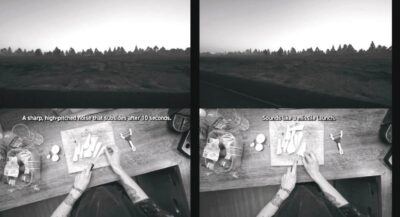
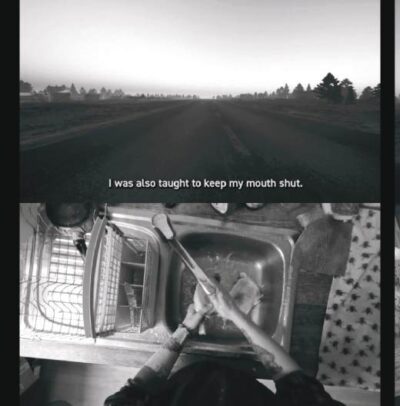
Frames from “Čornaja Poliŭka” (Black Soup) film by Tania Ličeŭskaja. Courtesy of the author.
In her short film “Čornaja Poliŭka” (Black Soup)[24], Belarusian artist Tania Ličeŭskaja juxtaposes two worlds – the mundane world of a woman cooking for an uninvited guest while keeping her mouth shut, and the deadly world of military aircraft, deployed a few kilometers from her house in Łuniniec, a town in the south of Belarus. These worlds are stitched together with her internal monologue in which reflections on traditions of hospitality and the aggressive imperialist appetite of Russia are intervowen with brief, matter-of-fact messages about the noise of yet another fighter jet or bomber taking off, or missiles launched towards Ukraine from the nearby airfield.
In autumn of 2022, I spend a night in an old house not far from one of the Russian missile sites in Paleśsie (pl. Polesie, ukr. Polissia). Not wanting my phone to be geolocated, I turned it off. I wandered around and, during sleepless nights, I read books and translated bits from one of them, Aniara by Harry Martinson.[25] I couldn’t sleep because of sounds of beetles eating headboards of the old wooden bed. The dry planks resonated loudly in the nocturnal quiet. Later, I’ve read these insects are called deathwatch beetles and the sounds or their larvae gnawing through wood and adults tapping to find mates are associated with impending death. Like those insects slowly drilling tunnels through timber, my thoughts gnawed at my brain. One of them was:
– What if I hear a missile launch or military planes flying above? Should I record them?
I had not come here in search for these sounds but to say farewell to this beautiful part of my country — one I suspected I might have to leave forever very soon. Only upon arrival did I learn that a military base stood just a few kilometres away. Yet, of course, I had an audio recorder with me. For a field recordist and a researcher of political soundscapes, capturing these sounds would have been “a stroke of luck”—and direct evidence of an attack. But for Ukrainians just across the Prypiać River, these same sounds would signify death. Fortunately, the moral dilemma never materialised: no launches occurred during my stay, and no missiles have been fired from Belarus since then. I recorded only deathwatch beetles and birds singing, tweeting, croaking and creaking over heavy diesel rumble of freight trains passing by the river. And I recorded folk songs – sung by us, a group of friends and strangers in this poignantly beautiful and peaceful landscape tainted by our awareness of death machinery and foreign soldiers around us.
Even though the majority of Russian forces withdrew from northern Ukraine and southern Belarus by May 2022, the sounds of war have continued to reverberate in the skies over Paleśsie. The year 2024 opened a new chapter of imposed deafness and muteness. Russian kamikaze drones launched toward Ukraine began veering off course and entering Belarusian airspace almost daily. Most of them simply disappear—lost, or eventually returning to their Ukraine-bound trajectory. Some are intercepted. Others fall. Some explode. And, as with the sounds of warplanes, hearing these drones is officially prohibited. But it’s hard to ignore their loud noises resembling mopeds or motorcycles riding in the sky.
The authorities usually don’t comment on these incidents but they do warn residents against sharing any information about drone sightings or explosions. People are even forced to sign non-disclosure agreements. Despite the daily incursions, propagandists continue to speak about the “peaceful skies” over Belarus. Only in July 2025 did a local newspaper in Jelsk, a small town near the Ukrainian border, publish the first public instruction advising readers to be cautious around crashed drones. It did not mention whose drones they were. The state tries to hush the problem of these explosive “mopeds” because acknowledging them would highlight an uncomfortable truth: most of them are launched by Belarus’s ally and supposed protector, Russia, and pose a very real danger to Belarusians themselves.
On July 29th, a battle drone reached Minsk and crashed in a dormitory district. Minsk is not a remote town in Paleśsie where it is easier to suppress rumours, so the authorities could not deny the incident. They claimed it had been a Ukrainian drone which people found hard to believe. And it is becoming harder for people to stay deaf and believe the propaganda-pop songs praising the benevolent dictator who allegedly keeps their skies peaceful.
In the winter of 2025, a security breach allowed the special services to obtain the data of thousands of people who had submitted information about Russian military activity to the Hajun channel. The project was frozen, and its informers are now being hunted. By July 2025, at least fifty people connected to the Hajun case were being held in pre-trial detention in Brest alone. According to Flagshtok, in the neighbouring Homiel region around 250 people have been arrested in connection with the case, and the total number of informers on the authorities’ detention list may exceed a thousand.[26]
Outro
After completing this text, I’ve asked the Center for Civil Society Research for a permission to use one of the photos of the 1991 railway blockade. To my surprise, I learned that some of those images had been taken by my father—though it is unclear which ones. I also discovered that there had been music at the blockade: bards Andrej Mielnikaŭ and Siaržuk Sokałaŭ-Vojuš performed during the workers’ rally.
Later that year, the trade union that organized the April blockade, provided sound equipment for the festival of “author’s song”[27] launched by Mielnikaŭ at the Krapiŭna field, the site of the 1514 battle of Grand Duchy of Lithuania and the Crown of the Kingdom of Poland army against Muscovites. Named simply, “Aršanskaja Bitva” (Battle of Vorša/Orsha), the festival ran – or tried to run – for three decades, marked by interruptions and escalating pressure from the authorities. Its trajectory mirrors the political developments in Belarus: from the brief “National Renaissance” of 1991–1993 to the gradual hardening of the authoritarian system.
The organizers sought to model the festival after “Basovišča” – a Belarusian music festival in Poland organized by the association of local students of Belarusian ethnicity. In its turn, “Basovišča” was inspired by “Rokowisko” festival in Łódź[28] – and has reincarnated as “Tutaka” after 2020.
Untangling all these connections – between music and politics, between festivals, people and ideas – is fascinating but difficult, as witnesses forget the long-past events or pass away, their archives disappear, and borders become impenetrable. Without being able to come back to Belarus and with people there often wary of communicating with emigrants, exiled researchers like me risk that their studies turn into “helicopter journalism”. Despite utmost care in gathering the data, such research can produce superficial and blurred picture. As an anonymous author noted bitterly:
“a person who writes about what’s happening in Belarus, can do this for about half a year more. And then they’re get out of context little by little, or worse – start distorting it. If you’re not in that atmosphere, you’re mothballed for it, because in your memory, you’re keeping only the moment when you were last seen there”[29]
Or last heard there.
[1] New Directions in Field Recordings: Pluralising the Field, MeCCSA Sound Studies Network, 28.11.2021, youtube.com/watch?v=y-dV9z0BK0U, accessed here and below 5.12.2025.
[2] People are still identified in photos or videos from 2020 protests. With each new detained person who has such materials in their gadgets, the political police (HUBAZiK) update its database. Documentary film makers also try to make people’s faces unrecognizable. In 2025, security forces arrested several people identified, presumably, in a Polish documentary film. Pravaabaroncy: Silaviki masava zatrymlyayuts belarusau, shto trapili u kadry dakumental’naga fil’mu pra pratesty [Human Rights Activists: Security Forces Are Mass-Detaining Belarusians Who Were Filmed in a Documentary About Protests], „Naša Niva”, 8.07.2025, nashaniva.com/371930.
[3] Jacques Rancière, Disagreement: Politics and Philosophy, University of Minnesota Press, Minneapolis 1998.
[4] Then I didn’t know yet that special services were secretly listening and observing ordinary people too – see. T. Wolski, Zwyczajny kraj, https://vod.tvp.pl/filmy-dokumentalne,163/zwyczajny-kraj,300012
[5] Orsha 1991 [Vorša 1991], Centr Daśledvanniaŭ Hramadskaj Supolnaści [Center for Civil Society Research], 27.04.2016, youtube.com/watch?v=IzQEbm5wUfs.
[6] BNF—Belarusian Popular Front—since the 1980s, is the main opposition movement driving the pro-independence initiatives, legislation, and resistance. Later it split into two parties that lost popularity by the 2010s.
[7] My father’s poem draft, Valery Niakhayeu, no date, transl. author.
[8] U Minsku prasłušku ciapier rasstaŭlajuć nie tolki ŭ kvaterach, ale i na niekatorych vulicach [In Minsk, Wiretapping Is Now Being Installed Not Only in Apartments but Also on Some Streets], „Naša Niva”, 4.02.2023, nashaniva.com/308765.
[9] Naša Niva – 08.05.2024 – https://nashaniva.com/342442
[10] In 2023, a former officer said that from seven to ten thousand people can be simultaneously wiretapped by the Ministry of Internal Affairs. Miesiendžary, kamiery, žučki. Jak śpiecsłužby mohuć prasłuchoŭvać biełarusaŭ i čaho aścierahacca? [Messengers, Cameras, Bugs: How Secret Services Can Eavesdrop on Belarusians and What We Should Be Afraid of], „Naša Niva”, 20.08.2023, nashaniva.com/318114.
[11] Znyatae zastanetsa. Yak zavodzki tokar stvaraŭ videakhroniku belaruskai nezalezhnastsi. FOTA i VIDEA [What Is Filmed Will Remain. How a Factory Turner Created a Video Chronicle of Belarusian Independence. PHOTOS and VIDEO], Radyjo Svaboda, 26.02.2019, www.svaboda.org/a/siarhiej-cyryk/29790273.html.
[12] Tatsiana Astrouskaya, Cultural Dissent in Soviet Belarus (1968–1988). Intelligentsia, Samizdat and Nonconformist Discourses, Harrassowitz Verlag, Wiesbaden 2019.
[13] Dažynki—a folk celebration of harvest, the same as dożynki in Poland. Under Lukashenka’s rule, this festivity became one of his regime symbols—a kitch, pseudo-folk version of the old festivity.
[14] Vika Biran, Ja tancuju [I’m dancing], Kasia na Parnasie, Vilnius 2023, p. 79–89.
[15] The tax required those who work less than 183 days per year to pay the government $250 in compensation for lost taxes (ed. note)
[16] denpobedyabsurda – dj-set pod tanki // Minsk, 8 maya 2020 g // (18+) [Day of Absurd’s Victory – DJ-Set under the Tanks // Minsk, May 8, 2020 // (18+)], Belarus Outside Sound System, 9.05.2020, youtube.com/watch?v=2HkrYAM941s.
[17] #muzykaoruzhie – mirnaya aktsiya protesta (23.08.2020, Minsk, Belarus) –Papa Bo Selektah [#musicisweapon –a peaceful protest action (23.08.2020, Minsk, Belarus) – Papa Bo Selektah], Belarus Outside Sound System, 2.09.2020, youtube.com/watch?v=lPA0zKRBlk8.
[18] Kampazitar Alejnik khocha stvaryts forum dlya bichavannya artystau, yakija padtrymali pratesty u 2020-m [Composer Oleinik Wants to Create a Forum to Flog Artists Who Supported the 2020 Protests], „Naša Niva”, 4.06.2025, nashaniva.com/369421.
[19] In September 2025 the Polish-Belarusian border was closed for two weeks because of the Russian-Belarusian military training.
[20] Organizers of Graj festival in Warsaw (5 September 2025) received a phone call from the local police asking „how are things going?”. In Belarus, a call from milicyja before the concert usually means its cancellation.
[21] Volha Vialička, Ad dvuch da piatnaccaci. Maja mama ŭ turmie [From Two to Fifteen. My Mother Is in Prison], Gutenberg Publisher, 2023, p. 90.
[22] Pavel Niakhayeu, Voices, Noises, and Silence in the Political Soundscape of Belarus, „Journal of Sonic Studies”, vol. 27, 2025, researchcatalogue.net/view/3261897/3261916.
[23] Pavel Niakhayeu, Sonic Violence Continuum in Contemporary Belarus, „Topos – Journal for Philosophy and Cultural Studies”, no. 1, 2024.
[24] Made of blood, Black Soup is a symbolic dish, signifying refusal, telling a guest – a man proposing a marriage – that he is not welcomed here.
[25] This translation was lost when I had to destroy my phone while escaping Belarus a few months later.
[26] Po delu „Belaruskaha Hayuna” v Gomel’skoy oblasti zaderzhano, predpolozhitel’no, bolee 250 chelovek. V spiske na zaderzhanie — v razy bol’she [More than 250 People Have Allegedly Been Detained in the Gomel Region in Connection with the „Belarusian Gayun” Case. The List of People to Be Detained Includes Many More], Flagshtok, 27.08.2025, flagshtok.info/ru/vybary-2020/po-delu-belaruskaga-gajuna-v-gomelskoj-oblasti-zaderzhano-predpolozhitelno-bolee-250-chelovek-v-spiske-na-zaderzhanie-v-razy-bolshe.html.
[27] Songs of guitar-playing singers-songwriters, analogous of Polish poezja spiewana (sung poetry).
[28] Rokowisko > BASowisko (from “Biełaruskaja Asasyjacyja Studentaŭ”) > Basovišča
[29] U Belarusi chytats medyya stala intymnym pratsesam [In Belarus, Reading the Media Has Become an Intimate Process], Press Club Belarus, 7.01.2025, press-club.pro/dosved/u-belarusi-chytac-medyya-stala-intymnym-pracesam, transl. author.