

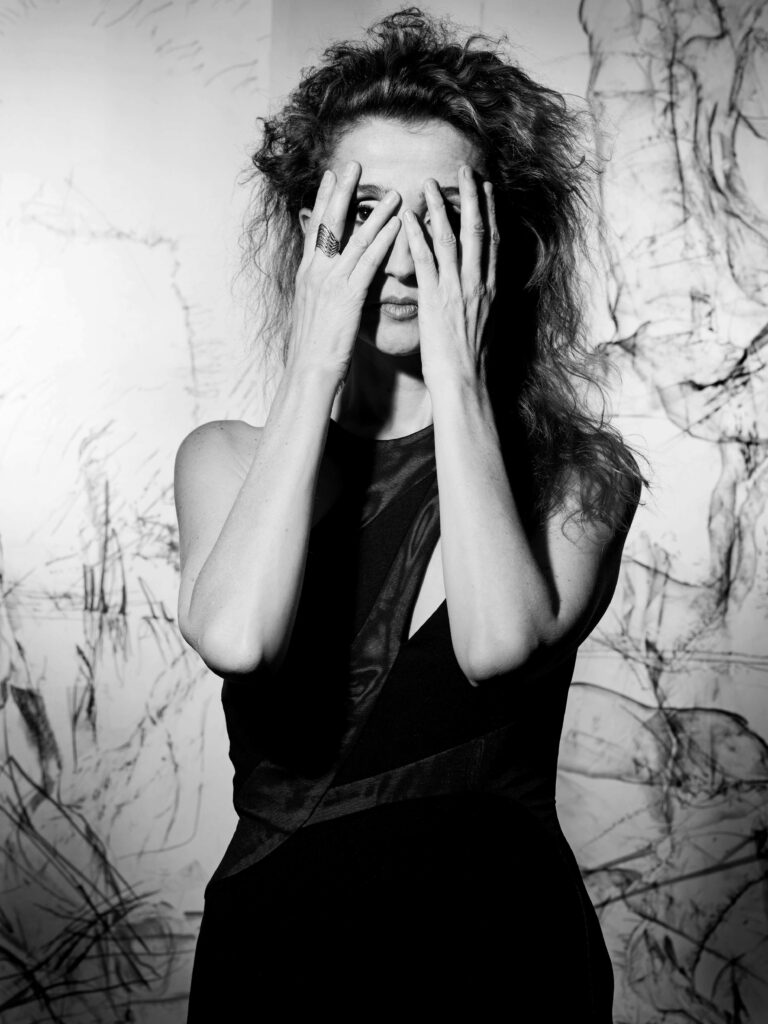
Architect of sound. Interview with Charlotte Hug
Małgorzata Heinrich: You have just performed at the Futurofonia Festival. Please tell me a bit about it.
Charlotte Hug: First of all, I’m really happy to be a part of this unique festival, and to contribute to the focus on the voice, which is also at the centre of my work. In my performance, there were, of course, my voice, the viola… but also Live-Scoring I used several brushes on big surfaces, and I was accompanied by a video installation. So, the audience experienced both audible and visual voices. You know, sociologist Hartmut Rosa says resonance can happen only if a subject listens to its counterpart and answers with its own voice. That’s very important for me—listening to “the other” and answering with my voice. This “other” can be people, but also nature; a glacier, for example.
MH: Like in your project Rhone?
ChH: Yes. It is a long-lasting project with the Rhone Glacier. I started it in 1999. It has been my longest-running artistic research project. And my most enduring project with nature—the relationship with the glacier… While preparing the performance in Poland, In Resonance with Elsewhere, I went there again. I studied its shapes, its shrinking, its changing forms. The glacier is endangered and might even disappear. To capture that, I looked for a medium that could visualise the constant change.
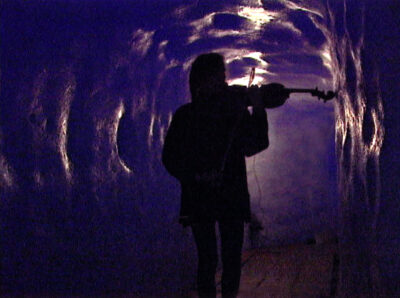
In the Rhonne Glacier, photo by Alberto Venzago
MH: What did you discover?
ChH: I spent a few months in China on an artistic residency from Pro Helvetia. You know, there is a tradition of Dishu, ground calligraphy. Chinese calligraphers paint with pure water on the stone. The water evaporates, and the poem or whatever they wrote disappears. During the time I spent there, I also painted on the stones, not Chinese calligraphy, of course, but Son-Icons—Visual-Sounds. I listened to what was happening around me, the panorama of sounds, and I drew that with both hands on the stones. Soon afterwards, it vanished, like sound. That was a big inspiration—to be able to draw something which disappears. And then I found a special Chinese tissue… When you paint it with water, it turns black, like ink. And when the water evaporates, the signs disappear, and the material is white again.
MH: Did you use them in Gdańsk, at Futurofonia?
ChH: Yes, I brought them with me to paint the Live-Scoring, the Temporary Son-Icons. Regarding the theme of being in resonance with nature, which is constantly changing and sometimes disappears, I thought these Temporary Son-Icons were the right medium to bring on stage. This performance was actually the premiere of the intermedia performance of a CD I recorded in 2025. The nucleus, however, remains acoustic—my voice and the viola. They are often symbiotic; they create a hybrid new voice when they mix. Sometimes you can’t even tell them apart.
MH: Is this project mostly about the resonance with nature?
ChH: There is resonance with nature, but also resonance with people. And there is quite an interesting story behind it. What inspired me to do this work was connecting with people I don’t actually understand. During my residency in China, I had a wonderful experience of resonance—a group at Xiangyang Park in Shanghai was singing. And of course, I didn’t understand the text, but somehow, I was deeply touched. I went over and started talking to them. They could understand some English words, and I could catch some Chinese. But it wasn’t enough; we couldn’t communicate with words. But then they started to sing to me, and I started to sing back. And then we just listened to each other while singing. They invited me to join them. And that was such a revelation to me: when you don’t understand each other, you just listen and connect. It was a wonderful encounter of resonance: listening to each other and answering in your own voice. We connected. In the performance, there is also a part of a spiritual sonic prayer, so being in resonance with metaphorical “elsewhere”.
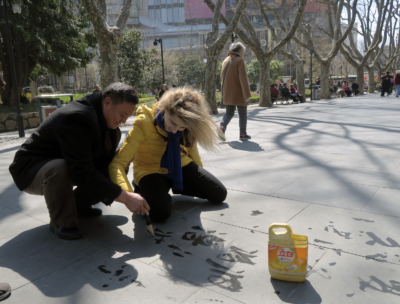
Charlotte Hug with her Master in Dishui, Xiangyang park
MH: How so?
ChH: I was an artist in residence at the Civitella Ranieri Foundation in Umbria, in Italy, and there were about 22 artists for several weeks. I created a performance setting for each person who wanted to contribute. I asked them to communicate with someone important to them who is gone, and to sing or speak in their mother tongue to that person. Each participant wore a sheet on their head to feel enclosed in their own space while still being acoustically connected to the environment. They sang and spoke in their mother tongues for half an hour, and I made a composition from those voices in Chinese, Amharic, Korean, Arabic, and many other languages from different continents. I used these recordings during a performance, which became much bigger than just me with viola and voice on stage; voices from all over the world were there.
MH: In your projects, not only is communication with other beings important, but you stay in resonance with spaces and sites as well.
ChH: Yes, absolutely. Spaces are very important. I like to perform in special or ambivalent places. I played, for example, in the House of Detention in London, which was a prison, but also a shelter during World War II. Or in the bunker Humboldt-Hain in Berlin. This Flak Tower, a heavily fortified bunker, served both as a hospital for expectant mothers and as a secure venue for entertainment, complete with an orchestra stage and other facilities for the pleasure and nucleus of operations for of Hitler’s most important people. This kind of ambivalence of shelter and centre of war.
MH: How about natural spaces? As you said, you work a lot with nature as well.
ChH: Of course, apart from urban spaces, I also play and conduct artistic research in natural sites. I am especially interested in places that are changing. For example, I played in South Africa at the Sterkfontein Caves, which means “strong springs” in Afrikaans. This is the area that constitutes the cradle of humankind. It is about 40 kilometres from Johannesburg. About two years ago, I also had a residency in Brazil, where I sang, drew, and conducted artistic research in the Mata Atlântica rainforest. I sang in a natural rainforest and in a rainforest shaped by human activity. I listened to it. I made drawings. They were both about connecting. When I draw Son-Icons, I use both hands. In our body language, we communicate with both hands; we play music with both hands, so I draw that way too. The gestures are very important to me. I draw on semi-transparent paper. And, if possible, I draw on the surfaces of the places I am in, for example, on the roots of the rainforest trees, on the rock, or on the glacier itself, because Son-Icons are not just a drawing; they are Visual-Music. I use the frottage technique. It’s also about incorporating the sense of touch. As the sound scans all the surfaces, I want that Visual-Music, the Son-Icons, to be connected with the surfaces and the surfaces’ chain. When you draw on an uneven surface, you can’t fully control the drawing.
MH: So the space leaves its imprint as well?
ChH: Exactly. This kind of drawing becomes the space’s imprint. The sounds connect with the environment’s structure, and through drawing I connect to it as well.
MH: When you draw your Son-Icons, is that the sound that you hear around you, or is it the sound images that you create in your mind?
ChH: That’s a very good question. There are different states of creating Son-Icons. For example, when I’m in the glacier, I listen; I come into this resonant relation. I listen to the voice of the other, and I answer with my own voice. Whatever I hear triggers my own imagination. When I draw, I usually do that on half-transparent paper. I draw on both sides. So, for example, one side is the listening, and then I turn it, and on the other side, it’s my answer. Then you can see it together at the same time. It’s actually a visualisation of touching, of listening, and answering with your own inner voice.
MH: It is a sort of visual and musical conversation with the place you’re in, right?
ChH: Absolutely. And then, of course, I also work in my studio. On-site experience is very important; it shapes my artistic work and my imagination. I bring this material, the Son-Icons made on site, and now I can turn it. I can read it from all sides. One direction is a completely different story than another. You can read it in retrograde or inversion. So, with one drawing, you can create eight different analogue versions. I also digitise it for video installations; sometimes I animate them. I play around with one drawing; at the same time, it is a visual magnet originating from a place and a trigger for my imagination.
MH: A little bit like a score? When you read it, you reconnect with the memory, but at the same time, you renew it and interpret it again.
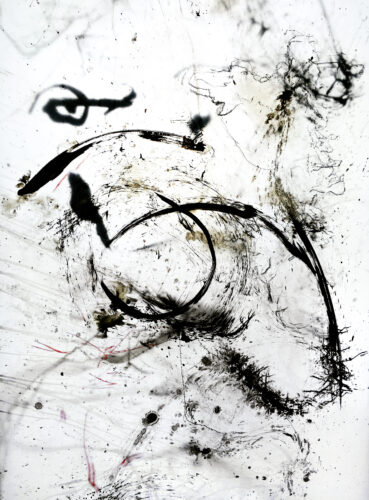
Son-Icon-Score
ChH: Yes. The Son-Icons become a score for me. And it gives me precise inspiration. How does a line start? How does it develop? How does it end? How do I sing and play this particular line in retrogradation? To translate sound into visuals is impossible; you never do it literally. It’s more like a metaphorical tracing or a translative process. The eye may have different choices than the ear. And it’s very interesting what you gain and what disappears in this kind of incongruity between the two senses. This is really driving my work. There is this very famous quote by Marshall McLuhan: “The medium is the message”. In my intermedial composition, the voice tells me another story than the viola. The body tells me a different story when I paint than when I play the music. And the visual score, the Son-Icon, tells me yet another story, and I like to integrate all these stories of the different senses. They show me various perspectives of my topic. I have further developed Son-Icons into a form of notation that can also function as a score for ensembles, choirs, orchestras, and interdisciplinary groups. Having studied both classical music and Fine Arts, I move fluidly between these fields in my artistic practice. Son-Icons are also exhibited in galleries and museums, where an installation can be transformed into a Spatial-Score for musicians to perform. On stage, I bring sound, visual art, and performance together in intermedia concert-installations, as I did at the Futurofonia Festival.
MH: You also like to include of scientific perspectives in your work.
ChH: Artistic research has accompanied me throughout my professional life. And I like to connect with scientists; another way of researching. For example, I had a project with Daphnia, small planktonic crustaceans; it was about acoustic pollution of the water. I collaborated with biologist Michael Grüter on a two-year cross-disciplinary research project. The scientists focused on how acoustic pollution influences the aquatic ecosystem. Daphnia magna are very, very sensitive small animals. The researchers were filming their reactions to sounds. And I was wondering, what sounds can I produce that the Daphnia like? With acoustic pollution, they get very aggressive, and you can see it in their movements; it’s a kind of brutal image. And my artistic research focused on what sounds these non-human species like. It was very interesting. For example, they loved the viola; not so much the voice, however. You would probably think the opposite. Maybe it’s because, with the voice, I’m like an animal, a dangerous animal [laugh]. We had a highly specialised camera, and we could really see how they moved. I also made a live performance with them.
MH: So, they seemed calmer when you played?
ChH: With the viola, they seemed calmer and more vivacious. To me, it looked as if they were dancing. I am not a scientist, of course, but the biologists could confirm that they did, in fact, behave as they do in vivid natural environments. They were lively, not aggressive. This project was very touching. It made me feel that you can somehow communicate with this non-human species. It took a long, long time. But in the end, I could find the right sounds. It is yet another form of resonance with elsewhere, the unheard voices of other creatures.
MH: In terms of elsewhere, you played in an ocean tide once! Could you tell me a bit more? The technical aspects of this project must have been very difficult.
ChH: Yes, this was in Ireland. As I told you, I like to be in touch with sites as much as I can. Observing the tides is wonderful. It leaves a very, very strong impression. Then I thought: how can I really go into it and feel this rising tide? This was during my residency in Coph at the Sirius Arts Centre. I was there for several weeks, and the idea took shape. Of course, I needed some infrastructure. Atlantic was very cold at the time; I needed a neoprene dress. The tide force is strong, so I also needed safety weights. I stayed in close communication with the ground manager and was observed throughout the performance. I have to say, it was a unique experience to really get in contact with the tide. I was playing for five hours on a very cheap Irish fiddle. It sounded better after that experience than before, to be honest [laugh]. I was playing, and the tide was rising. My body was becoming lighter. But at the same time, I needed more energy to play. It was very physical.
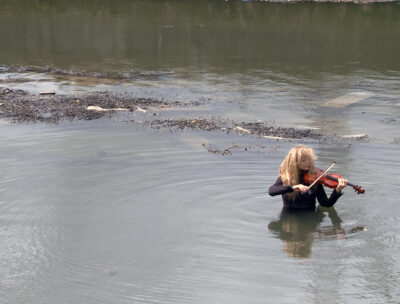
Atlantic in the flood, photo by Alberto Venzago
These rising tides, this enormous energy from the Atlantic, were an experience which you can’t really imagine without trying it. I tried to share it with an audience. I strove to reproduce what my senses felt with all the mediums I have; I try to share a multisensory experience. And the audience makes the experience theirs.
MH: You said that you like using urban spaces that are contradictory in their essence. On the other hand, in nature you search for changing environments, including endangered ones. But it seems you also tend to search for liminal spaces in your body—I am thinking of the Insomnia project. For that, you didn’t sleep for 40 hours, all the while playing and creating. Please tell me a bit more about this experience.
ChH: In my artistic research, I really want to confront myself with the topic I choose. Insomnia was commissioned by the Lucerne Festival, and the general theme was “the night”. We already have many nocturnes, so I asked myself what I could contribute, what interesting aspects I could discover for myself. I am a night person. I often work late and then go to bed at three o’clock or whatever. I started wondering what would happen to my body and artistically if I just didn’t stop working. I got in touch with a sleep researcher, Professor Dr.Peter Achermann from the University of Zurich, and he was interested in my motivated approach. My aim was to always leave an artistic trace, never stop. Either singing, drawing, playing the viola, or doing them simultaneously. I was doing Insomnia in the university sleep laboratory, under professional remote observation. Of course, I wanted an open-ended situation, but 40 hours is the maximum you can do without someone being physically present to supervise you and I wanted to do it alone to see the artistic result. It was extremely surprising, you know. You would think that when you sing for so long, your voice gets tired, maybe even sore, but the opposite happened. Afterwards, I could sing higher than I ever had before. The sleep researcher gave me two reasons for that. First, I followed my own rhythm exactly. I was in the laboratory. I had no sense of time. The light was always the same, the temperature was always the same, the humidity was always the same. I had absolutely no idea whether it was three o’clock at night or ten o’clock in the morning. In that situation, you just have to follow your own rhythm, and your capacity is much higher. Second, if you don’t sleep for so long, your body stays in an alert state.
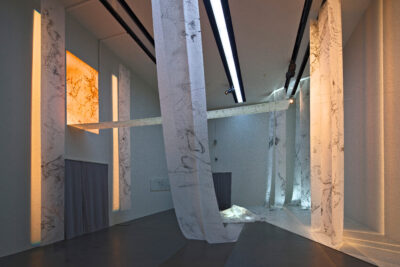
Insomnia Installation, photo by Stefano Schröter
MH: Like in survival mode?
ChH: Exactly. Let’s imagine you’re in a dangerous situation. Sometimes, the lounder but also the higher you shout or cry, the better your chances of being heard. This is the body that creates all that energy so you can do more than you normally would. So I knew my vocal cords could sing that high, but it took me more than a year to reach those very high notes without severe sleep deprivation.
MH: Did you observe any other effects?
ChH: When you don’t sleep, your body changes and you get very chilly. I was freezing. The project took place during winter. I had a very soft coat, and I put my paper on it because everything else felt chilly and hard, harder than normal. I found that when you draw on a soft surface, the drawing becomes kind of three-dimensional. You can really go into the depth of it, and you can see that reflected in your drawing. It became an important new stimulus for me. Another thing is what I called the “shapes” of insomnia—you move differently when sleep-deprived, and that, in turn, translates into a different language of sounds, of drawings, of shapes. It is very interesting. Like in the tides, when you have this full engagement with body and spirit throughout an experience in time, the change can really happen on various levels. And then distilling these specific shapes, these specific qualities of that experience, is an important part of my artistic research and my art.
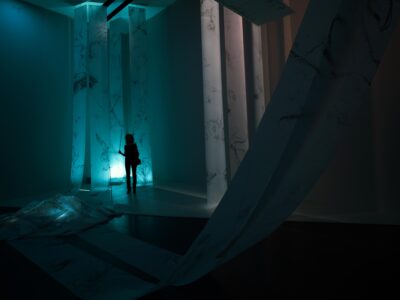
Spatial score Insomnia, photo by Alberto Venzago
MH: Especially that one of your main media of making art is a very intimate, bodily instrument—the voice. How do you work to shape it for specific projects? You have a wide, flexible range of vocal techniques.
ChH: I studied classical singing and viola and I am professor and teach contemporary singing, extended techniques, and improvisation at the University of Music in Lucerne. But the crucial thing is to find your own voice. It’s even more important now, in the age of artificial intelligence. Find your own voice. But how to do that? There are a plethora of ways to search for it. For me, one of the most important areas of artistic research for many years has been the oral cavity. We have the external space outside our bodies, but also this inner space which we have to get to know. The tensions, the volumes… I also do Son-Icons with this inner space, drawing the malleable shape of the airflow and its interruptions. As singers, we are interior architects of sound. And we have to create that architecture consciously.
MH: Can you tell me about some of your explorations?
ChH: I studied with Dieter Schnebel, who worked a lot with the mouth’s inner shape.
I still keep inventing and discovering new techniques of my own; I did a lot of artistic research in that. For example, in Ireland, I studied keening for five years. It’s an old Celtic Gaelic singing practice when a person dies. In the Celtic tradition, it is believed that there are five stages of dying. For four states, we have four voice registers, and the fifth stage is the Anderwelten, (other worlds) the state maybe in heaven? We don’t know, but the colours and the tastes there are much more intense. So, we have corresponding registers—undertones, chest voice, head voice, falsetto, and this special sound. The head voice is already almost in Anderwelten, the different world, you know. Then it goes to the falsetto voice, and in that transition, there is a very excited sound, like yodelling, but higher. It sounds a little bit like a bird song.
MH: How do you do that?
ChH: You learn to open and close your vocal folds, creating quick, crisp sounds that resemble bird calls. There is also a special movement of the tongue. The keener is like a medium. They are very sensitive to which state of going to Anderwelten the dying person is in. When the person shifts to another state, the keener makes this special sound. Keening is no longer practised, but I talked to many older women, and they shared their experiences with me. The practice was forbidden, as it was not a Christian tradition. But they did it anyway, and they remembered it. There are no recordings, as it’s a spiritual practice, and recording it would deprive it of a certain sacredness. I learned these techniques based on what I heard in the descriptions. And then I sang to these women, and they were like: “No, no, no, you’re not quite there”. Then, after five years, I had another residency, and I made an exhibition and concert at the Sirius Arts Centre. And one of the women came and said, yes, you got it. In In Resonance with Elsewhere, I also use this technique, of course, because this elsewhere has also to do with other worlds, with transitions, and different states of being.
MH: I see. You also use a lot of guttural sounds in your singing; where did you find inspiration for those?
ChH: For example, in the rainforest, you hear so many sounds. And if you want to communicate, you need to imitate and invent them, too. I want to listen and answer with my voice, and I search for ways to do this. In China, on the other hand, I worked with a music ethnologist, and I studied the shamanic tradition of singing while exhaling AND inhaling. The study of traditional and spiritual voices is very fruitful and interesting. But, of course, I’m neither a shaman nor a keener. I have to be at a certain distance and find my own way of resonating with it. In Resonance with Elsewhere was a particularly long-term project. I had been doing the research for many years. It also included topics like dying, breathing, and change. These are universal, so I want the sounds that communicate them to become a universal language as well. We all exhale; we all inhale. I want to find sounds for the energy of these very human and more-than-human rhythms and cycles. I’m searching for sounds to make unheard or unconscious situations audible.
MH: We talked a lot about being in change resonating with changing beings, but one of your main media of expression is a very inanimate body—an instrument, the viola.
ChH: I started playing violin when I was four; my grandfather was a professional violinist and my first teacher. So playing the violin, the fiddle, the viola is like my musical mother tongue. It’s deeply connected to my musical biography, and I still get gifts from the viola every day. But I also have to connect with it. The voice is part of myself, but the viola is an external instrument. The question is: how can we get in touch? What does the instrument offer me today? This process never stops. I discover a lot through improvisation. New sounds keep arising in dialogue with my voice. Interestingly, electronic music had quite a substantial influence on me in this aspect. Very early on, I collaborated with the Swiss Centre of Computer Music, which is now the Institute for Computer Music and Sound Technology. Working with electronics and composers who use electronics stimulated my acoustic fantasy. I had desires. I wanted to play polyphonically on the viola.
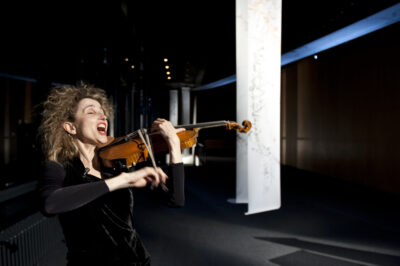
Berlin, Maerzmusik 2013 – Festival für aktuelle Musik, Charlotte Hug – Performance „Slipway to Galaxies”
MH: How did you find your way to do that?
ChH: I was in the mountains; they inspired me a lot, and still do. I treated them like a spatial score. I heard echoes, I heard birds, and I wanted to connect with this spatial score (especially since I work with spatial scoring on the stage as well). And there, in the mountains, in the Appenzellerland, I found out I could detach the frog from the bow and invert the construction. So the hair goes on top of the strings, the wood is underneath the viola, and I can play four voices simultaneously. I found out that I could also separate the hair and play behind the bridge and in front of the bridge—then I could actually play eight voices at the same time. I can sing multiphonics, so even without electronics I managed to have 10 simultaneous voices. Electronics need electricity, and I play in places where there’s often none. I needed techniques for playing polyphony without it. That was the real stimulus to experiment.
MH: I heard you call that technique of playing the viola a soft bow?
ChH: Yes. The soft bow isn’t just a trick; it’s a big part of my playing. I play about half and half with the normal bow and the soft bow. I’ve also developed many other bows, like the wet bow, for example, which I discovered while being overflown by the tide. I have about 30 bows. I’m kind of a bow fetishist [laugh]. But it really opens up other realms of sound.
MH: Do you also have a special one for soft-bowing?
ChH: In a live musical context, you need to be able to change fast. I collaborated with an industrial designer and a violin maker to make a special bow that lets you click and switch immediately between a normal bow and a Soft-Bow. We ended up with a special mechanism made of titanium. Everybody can play soft-bowing with a regular bow, though; you just have to screw out the hair, and it takes time. At Futurofonia, I had 4 different bows.
MH: It was not your first project in Poland. You collaborated with the Krakow Improvisers’ Orchestra. You also conducted them.
ChH: Yes. I had a fantastic collaboration with them. We really found common ground. With Paulina [Owczarek], we met in the London Improvisers Orchestra; she introduced the language of instant composing to the KIO, and I brought the Son-Icons. They are a wonderful stimulus for improvisation. But with a whole orchestra, you need additional coordination and inspiration. For that, I have developed something else: the InterAction Notation. With Paulina, we also did some co-conducting, and the results were absolutely fantastic.
MH: You mentioned InterAction Notation; could you elaborate?
ChH: I have been developing it since 2009, and it’s a different concept than Son-Icons, though it can incorporate them, as well as scenic simulations, video scores, and many other elements. It’s an interface for interdisciplinary context and can also be used by people who don’t read staff notation. It’s a common language between very different participants, even in an intercultural context. I used it for example for a dance company in South Africa. In the InterAction Notation I use about 50 symbols, which you read left to right. It mostly fosters interaction between the participants. For example, the instruction can be simple: imitate or mirror somebody. It also works well with Live-Scoring because it stimulates responses that may not be obvious. When I work with Live-Scoring, usually the first reaction of the musicians is to play immediately with the first brush stroke. So, InterAction Notation triggers more complex responses like: Listen to the first reaction; don’t look at Live-Scoring. What did you hear? Shadow what you’ve heard.
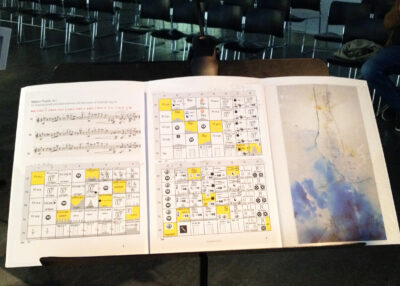
InterAction Notation, photo by Charlotte Hug
MH: It sounds like it allows you to create complicated performance situations.
ChH: Yes, it can work on many different layers. With InterAction Notation, I compose situations of unexpected reactions and impulses that probably wouldn’t happen without the score. I try to create more variability between the artists. InterAction Notation is also very flexible in time, but at the same time it allows you to be very accurate. I did a piece for 16 musicians moving in a big yoghurt factory in Zurich.
MH: Another unusual space!
ChH: Yes [laugh]. It’s huge. And I wanted to coordinate the musicians with the audience. So the instructions commanded, for example, “If the last person in the audience left, then go in the elevator to the terrace and start playing the duo”. The audience told me this was magical, that they were always in the right place at the right time. Of course, this is not magic, but you can really plan these kinds of conditional reactions within the InterAction Score and coordinate very complex situations. Also, while working with big, multidisciplinary groups of artists.
MH: Like the one in your project SIABA?
ChH: Yes. I collaborated with a whole dance company and its choreographer. But there was also another participant: nature itself. This piece was inspired by springs in Switzerland and in South Africa. We rehearsed in nature, and each creation in a specific space or place is really a co-creation, you know? Because nature shapes us. The question is: who really becomes the composer? Who accompanies? Does the dancer, with their movements, give a visual stimulus to the musician who interprets the body? Or is the music shaping the bodies, which is the more conventional relationship? Or maybe it is nature’s doing, the wind transporting the sound in a particular direction? Or perhaps it is the surface; do rocks give shape to the dancers? To the music with echoes? This kind of thinking of co-creation is a very important topic in my work.
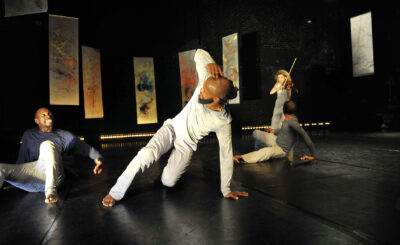
Siayba, photo by Jessica Deyschen
MH: And there, the InterAction Notations prove to be a very adequate tool to create.
ChH: Yes, and there is always room for co-creation, even in the compositions I write with InterAction Notation. Performers do not simply interpret my music; they can also bring their own ideas and artistic spirit into the piece. But InterAction Notation invites also for co-creation in the sense of co-composing. The basics are learned quickly, so it’s also useful in educational contexts, workshops, and masterclasses.
MH: I find it fascinating that there are so many players in your work. Even if you play solo, you play with the space, you play with the sound waves, you play with the visual, you play with nature, you play with other beings around you.
ChH: Of course, there is so much inspiration in the world around us and in the spaces we are in that we can connect with.
MH: What would you say is your biggest inspiration in this moment of your life and career?
ChH: You know, I always ask myself, what do I want to share? And I must say, right now these Temporary Son-Icons have a big impact on me. Also on an audience, apparently. This kind of energetic creation, visualising the time, this temporary aspect of music, the passing… How do these Temporary Son-Icons impact the music when they disappear?
MH: Especially that, while we know music is temporary, we treat the score and the visual as set in stone somehow.
ChH: Yes, I try to blend the distinctions, bring them together. This coexistence of different stories is something universal in us, after all.
Wywiad powstał we współpracy z festiwalem Futurofonia