

Should a Terrorist Attack Really Bring Cultural Life to a Halt?
Weronika and I are standing outside the UNA Music Café & Bookstore on Kraków’s Main Market Square. There are bullet holes in the shop’s large window. People stop to photograph them with their phones. Some move right up to the glass; others take pictures from a distance. It is two days after the shooting, and the bookshop has become a place where the city’s shock can be read in the glass and wood. Johann Wolfgang von Goethe stayed in this building during his visit to Kraków in 1790. On his deathbed, the poet is said to have uttered the words: “Mehr Licht! More Light!”
This is where we were supposed to have been two days before. Our friend Jan was due to present his new book as part of the Sacrum Profanum music festival. The book launch was scheduled for 4 pm. An hour earlier, a gunman had opened fire on the square. Now we are standing outside the bookshop, looking at the traces of violence. Inside, police officers are at work.
Ten minutes before the shooting, I had crossed Rynek Główny myself. I sat down at a café with a large glass façade overlooking the green park that surrounds Kraków’s old town. A message appeared in our WhatsApp group of seven journalists. Weronika wrote that someone was driving around the square shooting people.
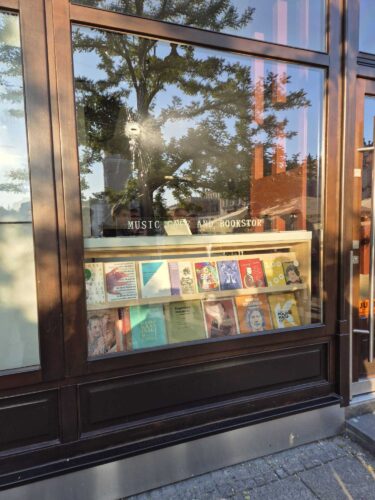
photo by Dorota Szwarcman
Almost simultaneously, I saw people running past the café windows. People and horse-drawn carriages moving at speed along the same path. A strange sight, as if two different realities had suddenly been forced into a single frame. Something had broken the city’s rhythm.
Weronika had fled into a hotel just a few metres from the bookshop and asked us to come and get her. I offered to walk the few minutes to reach her, but we were told to stay where we were. At that point, rumours were circulating that there might be more than one gunman.
Six people lost their lives and 16 were injured, including carriage drivers, tourists and two police officers. People sought refuge in cafés, souvenir stalls and Biedronka, the Polish discount supermarket chain named after the ladybird. For the next few hours, the city was gripped by rumours, fear and uncertainty.
It later emerged that the tragedy had also unfolded within the gunman’s own family. His 21-year-old sister, Magdalena Oksińska, was found shot dead alongside their parents in the family home in Ostrowiec Świętokrzyski. She was studying painting at the Academy of Fine Arts in Kraków and was herself part of the city’s art scene.
Kraków went into mourning. The familiar sounds of horse-drawn carriages disappeared from the streets. According to Polish media, it was the first time in 87 years that the city’s famous trumpet call, the hejnał mariacki, had not been played. The trumpet normally sounds every hour, around the clock, from the tower of St Mary’s Basilica. The melody breaks off abruptly halfway through. According to legend, the trumpeter was struck in the throat by an arrow while warning the city of the Mongol invasion in 1241. He never managed to finish the tune.
Now it was Kraków itself that had been struck. For twelve hours, the trumpet fell silent. The city’s tourist postcard had taken a blow.
Music often steps in when words have run out. But what does it mean when violence suddenly moves so close? What can art do in the face of death?
I had come to Kraków to hear music. I had been looking forward to the Ukrainian composer Katarina Gryvul, who now lives in the city, and the French ensemble La Nòvia. And to music written for machines and filtered through human bodies, computer logic translated into amplified banjos.
A few hours after the shooting, a small group of journalists and festival directors, without an audience, were given the opportunity to attend a concert by the Polish ensembles WCIAS (We Call It A Sound) and Kromlech. When the concert ended, we received the news: Sacrum Profanum, which had barely begun, was cancelled. So were all cultural events in the city, for four days.
Artur Zagajewski, one of the Polish artists who had managed to perform, later told me that this edition of Sacrum Profanum had been conceived around rituals and musical contemplation. His own work was intended as an inward prayer.
“Music is not just entertainment,” he said. When a festival places ritual at its centre, it also emphasises the spiritual dimension of contemporary music and its ability to create a sense of community. That becomes especially important when a society is struck by grief.
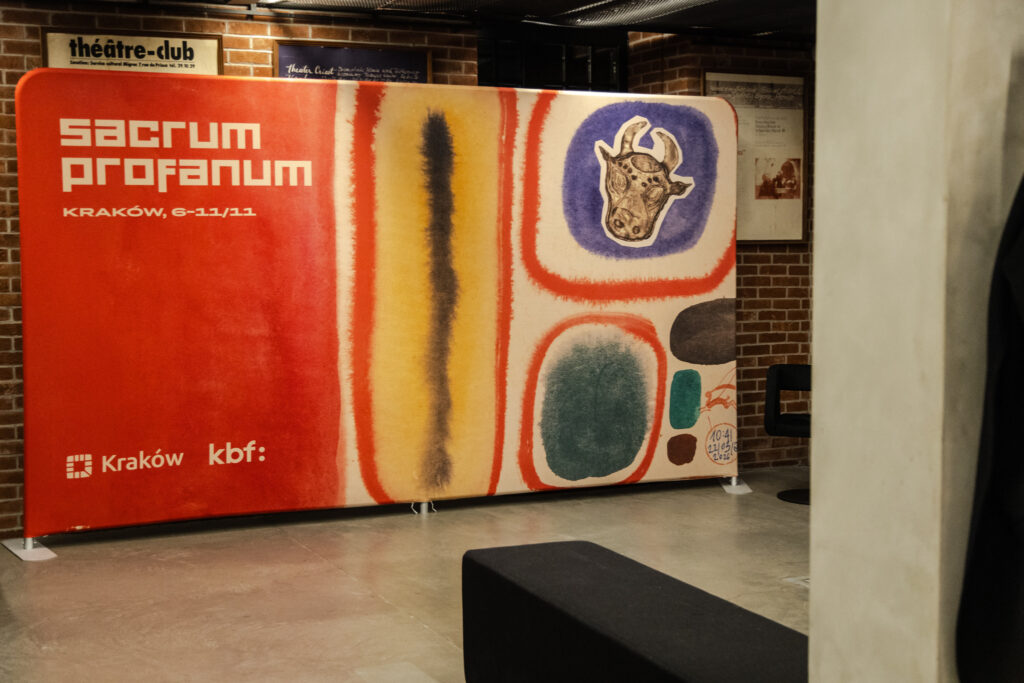
Sacrum Profanum, photo by Zuzanna Serwin
We needed to come together. To share a meal with the artists who had travelled to Kraków but were unable to perform. There was Ryosuke Kiyasu, who travels the world like a Japanese troubadour with his snare drum, giving physically demanding performances that have made him an international internet phenomenon. Millions have watched his videos, in which he throws his entire body into the instrument. But here he sat quietly and shyly beside me, eating beetroot soup and roast leg of lamb.
And there was Tomoko Hojo, who works with what she calls silent screaming: screaming without words. Drawing inspiration from figures including Yoko Ono, she explores the body’s and the voice’s capacity to express what cannot be put into words.
Over dinner, she tried to articulate what art might mean in a situation like this: „Art cannot fill your stomach, offer an immediate solution or instantly take away your pain. But it can make room for feelings that lie beyond words – uncertainty, helplessness, fear and the silent scream within us. Perhaps it can offer something very small that quietly grows inside us, something no one can take away.”
Three days after the tragedy, thousands march silently across the square. Neither the prime minister nor the president speaks. A trumpeter plays Simon & Garfunkel’s “The Sound of Silence”: “Hello darkness, my old friend, I’ve come to talk with you again”, and so on. No words. Just the sound of a trumpet, which seems so lonely among the thousands gathered. And yet there is something unimaginably beautiful about the sound of that particular trumpet in that particular square.
That same evening, I am invited onto Polish radio alongside the festival director to discuss the significance of art in the aftermath of the shooting. Among other things, I am asked how cultural life would respond in Copenhagen if something similar happened. I say it would depend on the circumstances, the events in question and the people responsible for making the decisions. You cannot establish rules in advance for how a society should mourn.
These were the questions our group discussed during what we came to call the Interrupted Festival. What do we actually expect from culture in times of crisis? Should it carry on as normal? Should it come to a halt? Should artists try to offer comfort or ask questions? And who decides when it is appropriate to play music when people have been killed just a few streets away?
In a way, the cancellation of the festival was just as significant as the shooting itself. We had travelled from different countries to come together around music that challenges our ideas of what music can be. Now it was precisely that coming together which had become impossible. Or perhaps, rather, it had taken on a different form.
We began meeting outside the official framework. Naturally, our conversations revolved around the shooting, but also around music, our work and the people we knew in Kraków.
I thought about how much of cultural life rests on the fragile assumption that the world outside will continue more or less as planned. That artists will be able to travel, that audiences will be able to gather, and that a concert venue in Aarhus or Madrid will be able to open its doors without having to take account of a tragedy on the other side of the street. Of course, that assumption is not always realistic. In many parts of the world, artists are already working amid war, censorship, political pressure or economic uncertainty.
We were reminded that culture does not exist solely in the works that are performed or in the institutions that present them. Culture is no substitute for the police, emergency services or social security. It cannot prevent every act of violence, and a concert hall is not in itself a safeguard against extremism. But neither is culture a luxury that society can afford to do without when serious things happen.
Cultural institutions are part of the public infrastructure. They provide space for disagreement and for experiences that do not fit into unequivocal narratives about the world. That matters in a time when extreme ideologies thrive on dividing people into us and them.
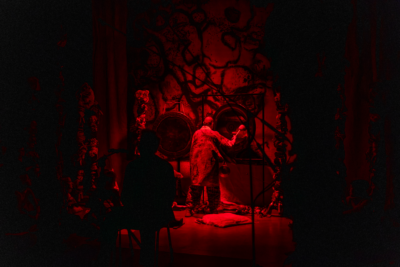
photo by K. Kukielka
Kraków’s trumpet call is itself a historical ritual. For millennia, trumpets have been used to warn populations, gather people and coordinate action in times of war and crisis. Their penetrating sound could travel far before loudspeakers, radio and digital alarm systems existed. But trumpets are also associated with entertainment and jazz
Today, the hejnał mariacki is something quite different from an alarm signal. It is a sound that connects the city’s inhabitants with its history and with one another. It marks the passage of time and reminds us that some rituals survive across generations. That someone is still standing in the tower, playing. When the trumpet fell silent, Kraków briefly lost one of its most recognisable shared rituals.
In Polish, there is an expression: urwany dźwięk – a sound cut short. It also describes what happened to Kraków in November, or Listopad, the Polish word for the falling of leaves. I do not know whether art can make us better at living with such ruptures. Perhaps it is not its task to repair everything. Perhaps, above all, it should keep a space open for what we cannot yet comprehend – and for the people we might otherwise risk turning away from.
During the Interrupted Festival, our group created rituals of our own. We immersed our bodies in the icy water of a former limestone quarry, surrounded by dramatic cliffs, while listening on a mobile phone to some of the artists who had been due to perform at the festival. It was not an attempt to resume the programme. We were people who needed to be together and had found a way to do so. We listened to No Sound by Jessica Kenney and Eyvind Kang. The vocals had a chant-like quality. The viola moved in slow motion over the icy water.
We talked an extraordinary amount during this festival. One festival director from Strasbourg said: At festivals, people usually talk about the music they hear. But at Sacrum Profanum, we had imagined so much music.
Art is also about dreams. When a festival is interrupted, a future that had already begun to take shape disappears with it. In Kraków, I learned that it is possible to share dreams with other people.
Weronika said she wanted to go home because writing about the Interrupted Festival here in Kraków was too difficult. But she is still here. She has just organised a listening session in her hotel room.
We continue to talk about all the music we did not hear, but which one day we will hear together.
Andreo Michaelo Mielczarek is a writer and cultural journalist. The article was first published in Danish magazine Politiken. Proofreading: Seb Doubinsky