

A balance between intuition and reflection. Interview with Abul Mogard and Grand River
For the last decade, Berlin-based Dutch-Italian composer and musician Aimée Portioli, aka Grand River, has been circling the perimeter of electronic music and sound art, crafting heady electroacoustic soundscapes for acclaimed labels while simultaneously devising ambitious multichannel installations and rupturing the boundary between the gallery and the performance space. Most recently, she debuted Symphony for Endangered Birds, a 7-channel sonic examination of vulnerable bird species, at Essen’s Museum Folkwang. Inspired by vintage kosmische music, film scores, experimental rock, ambient music and avant classical sounds, Portioli has devised her own unique signature, a vivid and painterly sonic landscape that’s viscerally driven by the unconstrained emotional language she developed when she studied as a linguist.
Abul Mogard is the alter ego of Italian musician Guido Zen, known for evocative albums and immersive live performances. His work centres on the use of synthesisers and both analogue and digital sound processing. He has appeared at prestigious festivals and venues including Berlin Atonal, Poesia en Voz Alta in Mexico City, the Centre Pompidou in Paris, Centro de Cultura Contemporánea Condeduque in Madrid, Auditorium San Fedele in Milan, Le Guess Who in Utrecht, Mutek in Montreal and the Southbank Centrein London. His work extends to film, including soundtracks for Duncan Whitley’s Kimberlin and Phoenix City, the latter commissioned by the Coventry Biennial. Mary Anne Hobbs has listed his remixes for Carl Craig and Fovea Hex with Brian Eno among her favourite tracks on BBC Radio, and Thom Yorke has included his music in mixes for NTS Radio and the BBC.
In 2024, Aimée Portioli and Guido Zen meditated on the idea of emptiness on In uno spazio immenso, an album that Resident Advisor described as „theatrical and emotional ambient with a post-punk edge.” Dynamic and poignant, In uno spazio immenso balances on a knife-edge between booming, operatic grandeur and soft-focus simplicity, casting as much light on the subtle outlines and illusory rhythms as it does its dense, almost overpowering textures.
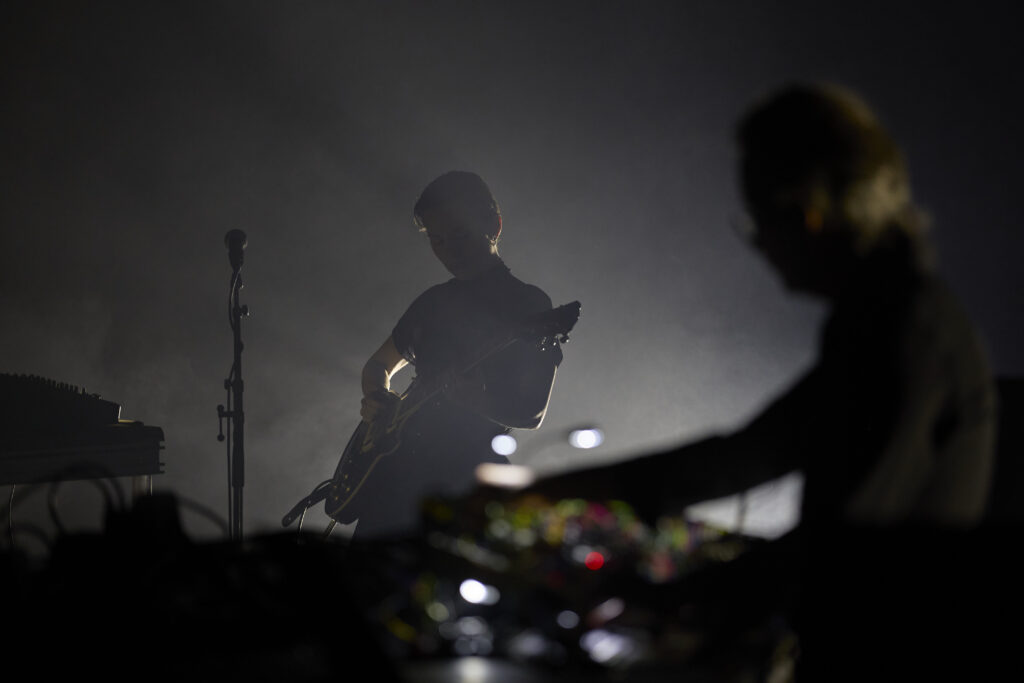
Abul Mogard & Grand River (Photo by Vivien Gaumand)
Natalia Glinka-Hebel: Aimée, you studied linguistics. How much does this background influence your music? Does it reflect the sound structures you use, is it a part of the narrative you create or maybe it makes you more sensitive to the timbre of particular structures, as it was with your moniker, Grand River?
Aimée Portioli: Although I eventually chose a different path, I think studying linguistics shaped the way I observe and think. Language and music are both systems of communication, but what has always fascinated me is where language reaches its limits and music begins. There are emotions and experiences that I simply cannot express with words, and composing has always been my way of giving them a form through sound. I do not think my background directly influences the structures of my compositions in a technical sense, but it probably made me more attentive to listening, to the nuances of sound and to the relationship between meaning and perception. Those are ideas that continue to accompany my work today.
NGH: Your music portrays emotions – something I would call the sensation of the moment – rather than static, concrete images. What are your artistic means to achieve this profound effect?
AP: Emotion has always been the starting point of my work. More often than not, I begin with a feeling that I want to explore rather than with a musical structure or a specific image. Through composition I try to externalise those emotions, and sometimes I even discover them more clearly in the process. From there, everything else becomes part of the language I use to express them: harmony, timbre, texture, dynamics, silence, space and time. I do not consciously think about creating a particular emotional response in the listener. My focus is on being as honest as possible in translating my own experience into sound, leaving space for each person to build their own emotional relationship with the music.
NGH: I would also like to ask about your 2025 album (based on a piece from 2022), Tuning the Wind. It evokes the title of the pioneer work in sound ecology, The Tuning of the World by R. Murray Schafer. Was the recording somehow inspired by the book? I get the impression that sound ecology is a topic close to your heart (I think, for example, about your sound installation Symphony for Endangered Birds) and that your oeuvre is close to the concept of soundscape and you also employ field recordings in your music (this is getting even more interesting if we think about 2023 book by Fanny Gribenski, Tuning the World, that tells the story of how the musical pitch A 440 became the global norm).
AP: The title was not directly inspired by R. Murray Schafer’s The Tuning of the World, although I have great respect for his work and for the impact it has had on the field of acoustic ecology. Tuning the Wind originated from a site specific installation I created in 2022, where the wind itself became both a physical and conceptual presence within the work. More broadly, I have always been interested in our relationship with the environment through sound. That interest naturally found its way into projects such as Symphony for Endangered Birds, but I do not consciously approach these works from the perspective of sound ecology. I simply follow the questions that each project raises and the context in which it exists. Field recordings are part of my practice when they are meaningful to the work, but I do not think of them as documentary material. Once they enter the compositional process, they stop being recordings of a place and become part of the musical material itself, transformed and placed in dialogue with every other sound within the composition.
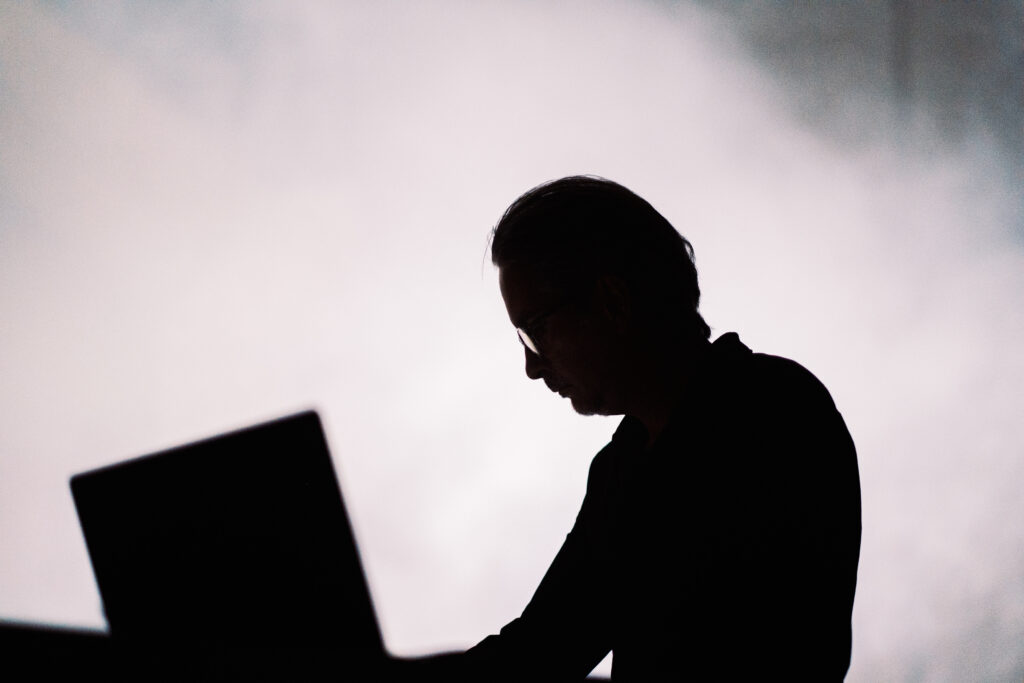
Abul Mogard (Photo by Helena Majewska)
NGH: Now I have a few questions for you, Guido. Among your different projects, you also created film music. Your work seems to create picturesque landscapes – or rather soundscapes – as well. Do you find cinematicity in your creations important?
Guido Zen: I like the fact that each listener might find their own scenes in my music. So I suppose I like my music to have a cinematic quality, but my aim is to keep the work open to personal interpretation rather than making it particularly narrative. When I compose for film it is slightly different, because the images, or the story, might already be there and the music will have a certain connection to them. In any case, I still like to leave space for the images and try not to make the music too literal.
NGH: In one of the interviews you mentioned that you like when things go out of hand or in an unplanned way. Does it work for you also when you cooperate with other artists?
GZ: Yes, of course. In a live performance, it’s quite common for things to go out of control, and I think that can be an interesting place to navigate and enjoy. In the studio, it can also happen during a session with another artist, or even when working remotely. The other person might add something that suddenly takes the music in a completely different direction, and that direction can be better than what I originally envisioned.
NGH: Among your artistic partners one can mention Rafael Anton Irisarri, CoH or Aimée Portioli aka Grand River. How much of Guido is in those projects – do you continue the same creative vision while working with other people, or do you rather set it aside and blend into this new entity that is created between you and them?
GZ: I tend to approach each project in the same way, which is to try to be guided by the sounds. I react to sounds I create, or to material that someone else creates, in much the same way, quite instinctively. What I find important is being able to abandon ideas if they’re not working. That’s true of my solo work, but it becomes especially important when I collaborate. In a collaboration, it’s equally important to trust the other person and leave room for them to work and take the music somewhere you might not have expected.
NGH: Your latest album, Where Light Pauses in the Silence of the Sun, a collaboration with Rafael Anton Irisarri featuring Martina Bertoni and Andrea Burelli, has been out for slightly over two months. How do you perceive it right now?
GZ: It’s an album I’m very fond of. We put it together fairly quickly by my usual standards, and I like the spontaneity of that. I think some of it also comes from the original material, which was recorded live in Berlin last year, in front of an audience. That made those parts quite unique and led to some unexpected and interesting moments. Listening to it now, I think that spontaneity is still one of the things I like most about the record.
NGH: Let’s now talk a little bit about your cooperation. Your album In uno spazio immenso is very intimate and emotional. I would describe the music on it as fragile yet powerful. This is not an easy effect to achieve. What did the creative process for it look like? Did you have a clear view of what you want to achieve, or was it rather similar to recording sessions of improvisation?
AP: In uno spazio immenso was a very personal record, and because of that the process was quite intuitive. We did not begin with a fixed idea of what the album should become. We knew the emotional territory we wanted to explore, but we tried to leave enough space for the music to evolve naturally throughout the process. We would not describe it as improvisation, although spontaneity certainly played an important role. The pieces developed over time through composition, experimentation and careful listening. We spent a long time refining details, questioning decisions and allowing the music to gradually reveal itself. For us, composition became a balance between intuition and reflection. There has to be enough freedom for unexpected things to happen, but also enough distance to understand when a piece has found its own identity.
NGH: Also, you mention that the album dwells on the idea of emptiness. How is the concept explored in your work?
GZ: For me, emptiness in the album is not really about absence, but about space. I think there is something interesting in leaving things open and not filling every moment with sound. We explored that through the contrast between very dense moments and much more sparse and suspended ones.
NGH: You somehow bridge two generations of Italy’s experimental music scene. Could you share the story of how your collaboration started?
GZ: It all started at the end of 2021, when Aimée contacted me about a possible collaboration or split release. I wasn’t aware of her music at the time, but after listening to her 2020 album Blink A Few Times To Clear Your Eyes on Editions Mego, which I really enjoyed, I thought that our different approaches could actually work very well together. So we started sending each other ideas for tracks, trying to work outside our comfort zones and experiment with new things. I’m very happy with the result and with how working with Aimée pushed me to do things very differently from how I would have done them on my own.
NGH: Where would you place In uno spazio immenso among your own individual records? Does it open a new chapter for you, is it rather a one-time adventure or maybe you plan to continue working as a duo?
AP: In uno spazio immenso will always have a special place within my body of work because it was my first collaborative album. Sharing such a personal creative process with someone else was both challenging and deeply enriching. It taught me a lot about trust, dialogue and finding a common language through music. I do not really think of it as opening or closing a chapter. Every project marks a moment in my artistic journey and leaves something with me that naturally finds its way into whatever comes next. And yes, we have been thinking of making another record in the future.
NGH: We will soon hear both of you at Open Source Art Festival in Sopot, Poland. How do you feel about performing on a scene of a festival that is already a trademark itself, with quite an established audience?
GZ: Every concert is different and brings a different atmosphere. We react to it, and I think this is a part of what makes each show interesting and unique. I performed at the Open Source Art Festival back in 2022 with Marja de Sanctis as an A/V show, and we really enjoyed the experience and the atmosphere of the festival. So I’m very happy to be coming back, this time with Aimée, and to see how this music develops in that space.
Abul Mogard and Grand River will perform during Open Source Art Festival in Sopot on 4 September 2026. The information and tickets can be found here: https://osafestival.pl/